
The spark of what should be: What does it mean to be idealistic?
The spark of what should be: What does it mean to be idealistic?
Imagine witnessing an everyday injustice in your environment, such as highly unequal treatment of a colleague in your workplace.

An inner voice tells you that you must intervene, demand respect, and report the incident, regardless of the consequences. That voice does not calculate the cost of the action nor measure whether the effort will change the system immediately; it simply points to what is right.
That impulse is the idealistic attitude. We are not referring here to the metaphysical idealism of Plato or Kant, which discusses whether matter exists outside our minds. In practical life, idealism is an ethical and vital posture: the conviction that our actions should be guided by how things should be —by justice, honesty, or solidarity— and not by how they actually are.
Whoever adopts this stance refuses to accept the world's imperfection as an inevitable destiny. Their compass points to a high standard. However, this pursuit

of absolute coherence harbors a constant tension.
When the ideal becomes a rigid and inflexible demand, the risk of paralysis arises: the idealistic person may prefer not to act rather than accept an imperfect solution, or feel deep frustration when clashing with the inertia of daily life.
<quizid="20365e8d-9569-5aaa-b175-3ecd47843cbf" type="multipleChoice" subtype="singleAnswer" points="5" orderConstraint="first">
What is the defining characteristic of the idealistic attitude in the ethical sphere?
options:
- Seeking the option that generates the greatest economic benefit in a group.
- *Acting with fidelity to principles of justice and correctness, prioritizing what should be.
- Avoiding complex decisions to avoid facing negative consequences.
- Adapting personal values to the specific demands of the social environment.

feedback:
The ethical idealistic attitude focuses on what should be, prioritizing correct principles and values over pure convenience or the calculation of results.
</quiz>
The collision with the possible: Pragmatism on the scene
In contrast to idealism stands pragmatism. It is not about selfishness or a lack of values, but rather a different way of understanding moral action.
- Critical workplace case
- Detection of a critical architectural error
- The client's tech lead imposes an unsustainable database design that will cause severe scalability failures in a few months.
- Idealistic Route
- Pragmatic Route
- Relationship preservation
- Final software soundness
- Immediate benefit
- The technical error is confronted directly on the same day. The technical stance remains free from ethical or quality compromises.
- Side effect
- The client's lead gets defensive, breaks fluid communication channels, and the team is labeled as problematic.
- Idealism values pure technical truth, but by ignoring the listener's psychology, it often triggers political defenses that block the real solution.
For the pragmatic stance, the value of an idea or decision is measured by its practical consequences and its ability to solve real problems.
The pragmatist observes the same unjust workplace environment and asks: "What can I actually achieve here and now with the available resources?". If directly confronting the boss means the immediate dismissal of everyone involved without solving the underlying problem, pragmatism will seek an alternative route: a discreet negotiation, a gradual change, or an intermediate solution that sustainably improves the situation.
| Criterion | Idealistic Attitude | Pragmatic Attitude |
|---|---|---|
| Main focus | Principles and what should be | Results and feasibility |
| Relationship with context | Demands that reality adapt to the ideal | Adapts action to real limits |
| Main risk | Paralysis from excessive demands | Justification of questionable means |
The danger of radical pragmatism is conformism or cynicism: accepting that "that's just how things are" and ending up dissolving moral principles under the excuse of necessity or that "it's the only option".
The dilemma of action: Negotiable limits or absolute principles?
In everyday life, this tension does not present itself in grand philosophical treatises, but in daily crossroads where both approaches seem to have valid arguments.
Consider the dilemma of honesty versus nurturing personal relationships. If a very close family member asks for your opinion on a project in which they have invested all their enthusiasm, but which you consider an obvious mistake, what do you do?
- The idealism of sincerity demands that you tell the raw, unvarnished truth, because lies, even white ones, corrupt trust and respect

for the autonomy of the other.
- The pragmatism of care suggests softening the truth or highlighting only the positive, evaluating that devastating criticism will cause immediate emotional harm and weaken the emotional bond, without bringing any clear benefit at that moment.
Is there a meeting point between both extremes when facing an ethical dilemma?
Yes. It consists of using idealism to define the direction of the action (the what and the why) and pragmatism to design the most constructive strategy to carry it out (the how and the when).
Neither of the two stances is inherently superior. Without idealism, our daily decisions lack ethical direction and become purely reactive to the environment. Without pragmatism, our noblest intentions remain abstract discourses that do not improve anyone's life.
<quizid="4c74e0cb-6eae-5d5e-bde1-8acc999568b8" type="fillInTheBlank" points="5" orderConstraint="showAfter(20365e8d-9569-5aaa-b175-3ecd47843cbf)">
When a professional decides to deliver a project they know is imperfect because the deadline is due and resources are limited, prioritizing the utility of the delivery over the perfect standard, they are adopting a ____ stance.
options:
- *pragmatic
- utopian
- dogmatic
Answer: pragmatic

feedback:
The pragmatic approach accepts imperfection and works within the limits of the context (time and resources) to achieve a useful and real outcome.
</quiz>
Idealism as a driver of historical change
On a large scale, insisting on what society considers "impossible" has been the driver of humanity's most profound changes. The realism of each era usually defends the status quo because it works
and maintains the existing order. If we had only been pragmatic, many today's realities would never have existed.
- 19th Century · The 8-hour workday
Working 14 hours a day in factories was the norm considered realistic by industrialists. Demanding "eight hours for work, eight for sleep, and eight for leisure" was labeled a utopian delusion. The idealistic persistence of labor movements redefined work globally.
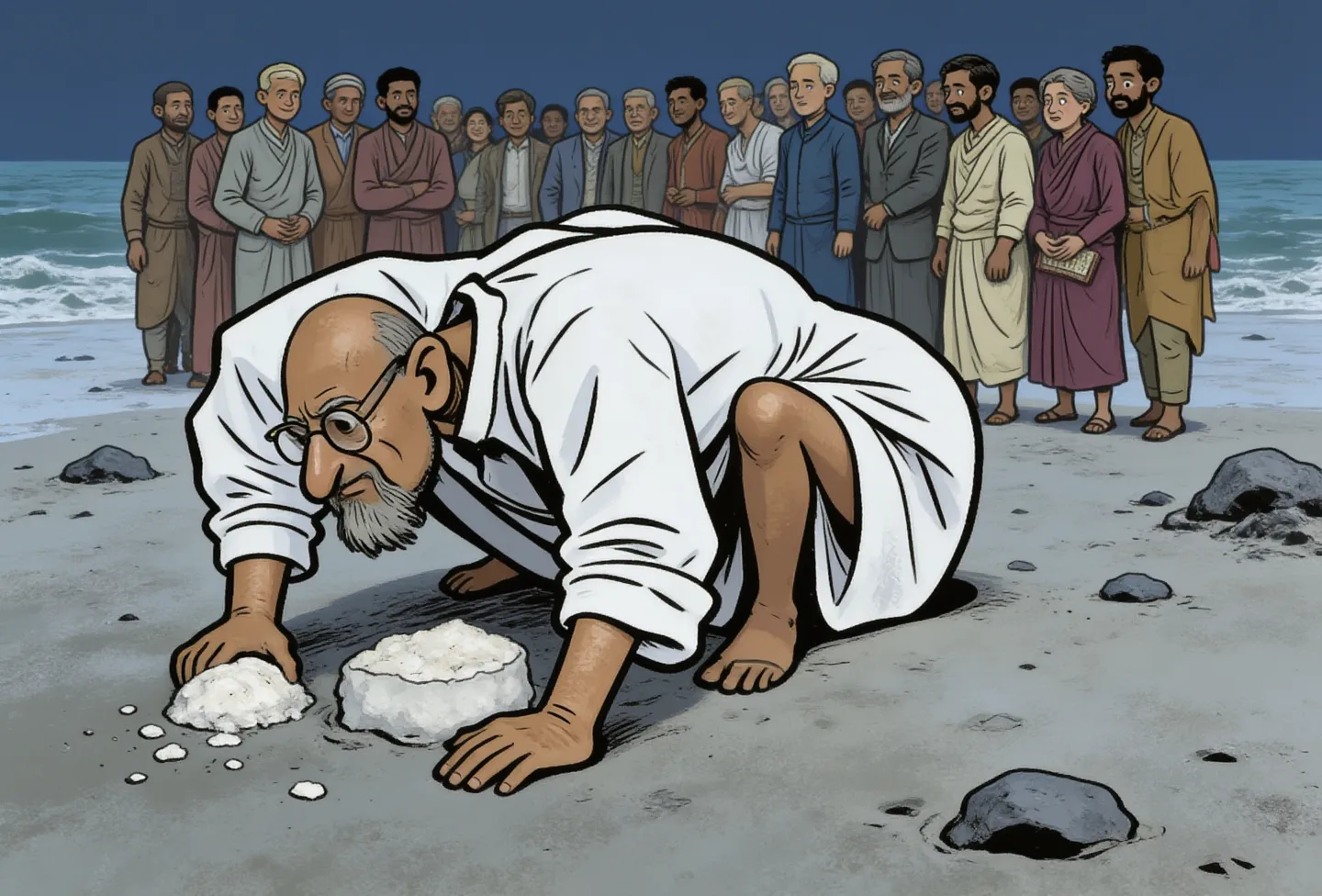
- 1930 · Gandhi's Salt March
Faced with the military power of the British Empire, the idea of achieving Indian independence through nonviolent civil disobedience seemed naive. Gandhi proved that a firm moral principle could bend the arm of a superpower without firing a single weapon.
- 20th Century · Women's suffrage
The notion of women having political rights and full voting power was rejected on the grounds that it would alter the "natural order" of society. The perseverance of the suffragettes turned that utopian demand into an unquestionable democratic right.
These examples remind us that the limits of what we consider "possible" are not laws of physics; they are temporary social agreements that idealism can challenge and transform over time.
The necessary synthesis: A grounded idealism
How, then, do we navigate our daily decisions? The answer is not to choose a side, but to learn to integrate both forces. The American philosopher and educator John Dewey suggested that ideas and values are tools for action. An ideal that does not translate into concrete behaviors is nothing more than an illusion.
To build a grounded idealism, we can apply
- The balance of action: idealism and pragmatism
- IDEALISM (Direction / Purpose)
- PRAGMATISM (Action / Progress)
- Adjust the levels to begin the journey towards the ethical goal.
- Reset
- Reset simulation
- Goal reached! Perfect balance between vision and real action.
- Good path. You are connecting ethical vision with practical execution.
- Too much pragmatism but no clear ethical path. You are advancing without a compass.
- Too much ethical theory but no execution capacity. You remain floating.
- Seek balance by raising both controls to reach the goal.
- GOAL
a decision-making process structured into four steps:
- Define your compass (the ideal): Identify the fundamental ethical principle at stake (honesty, solidarity, respect).
- Acknowledge the terrain (the limits): Coolly analyze resources, risks, and context viability.
- Take the possible step (the action): Find an action that, even if it does not reach the perfection of the ideal immediately, moves you in that direction while respecting reality.
- Evaluate and adjust (the learning): Observe the effects of your decision and correct course without losing sight of your compass.
In this way, idealism avoids becoming a useless and frustrating utopia, while pragmatism avoids degrading into unprincipled conformism. Connecting the height of our goals with the reality of our possibilities is the true art of ethical maturity.
<quizid="a426bb1f-e001-5ba7-a5ff-f34b01bf1646" type="trueFalse" points="3" orderConstraint="showAfter(4c74e0cb-6eae-5d5e-bde1-8acc999568b8)">
Does seeking a balance between idealism and pragmatism imply that we must completely renounce our principles when reality is difficult?
options:
- True
- *False

feedback:
Balance does not require renouncing principles, but rather using them as a compass to guide real steps, adapting the strategy to the context without losing the ethical direction.
</quiz>
Sources
References
- Santamaría, D. Pragmatic idealism in everyday decision-making.
- Amnesty International. Historic protests: Examples of the power of social action against the impossible.
Bibliography
- Kant, I. *Critique of Practical Reason*. Alianza Editorial, 2013.
- Dewey, J. *Human Nature and Conduct*. Fondo de Cultura Económica, 1964.