
Dutch Origins and the Realist Period
Dutch Origins and the Realist Period
Before the yellow spirals and vibrant skies, Vincent van Gogh's painting was somber, earthy, and dense. During his formative period in Holland (1880-1885), influenced by the social realism of François Millet and the tradition of the Flemish masters, Van Gogh turned his gaze toward the austere lives of rural workers.
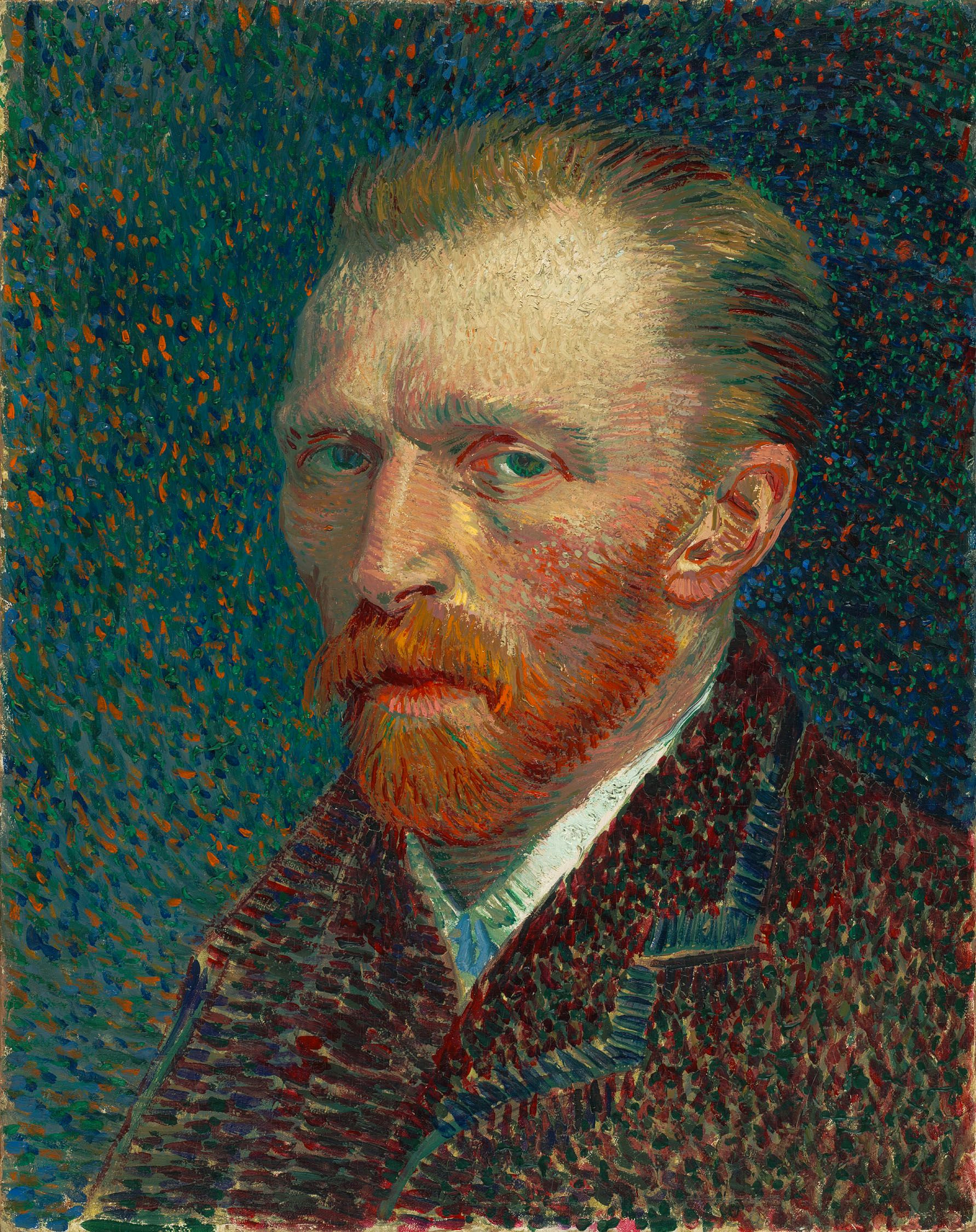
His goal was not to stylize poverty, but to capture the physical dignity of manual labor. In this initial stage, his color palette depended almost exclusively on dark tones: browns, ochres, olive greens, and toasted shadows.
The masterwork of this period is «The Potato Eaters» (De Aardappeleters, 1885). In it, he depicts a peasant family gathered under the dim light of an oil lamp. The hands deformed by hard work and the weathered faces express a deep connection with the land they cultivated themselves.
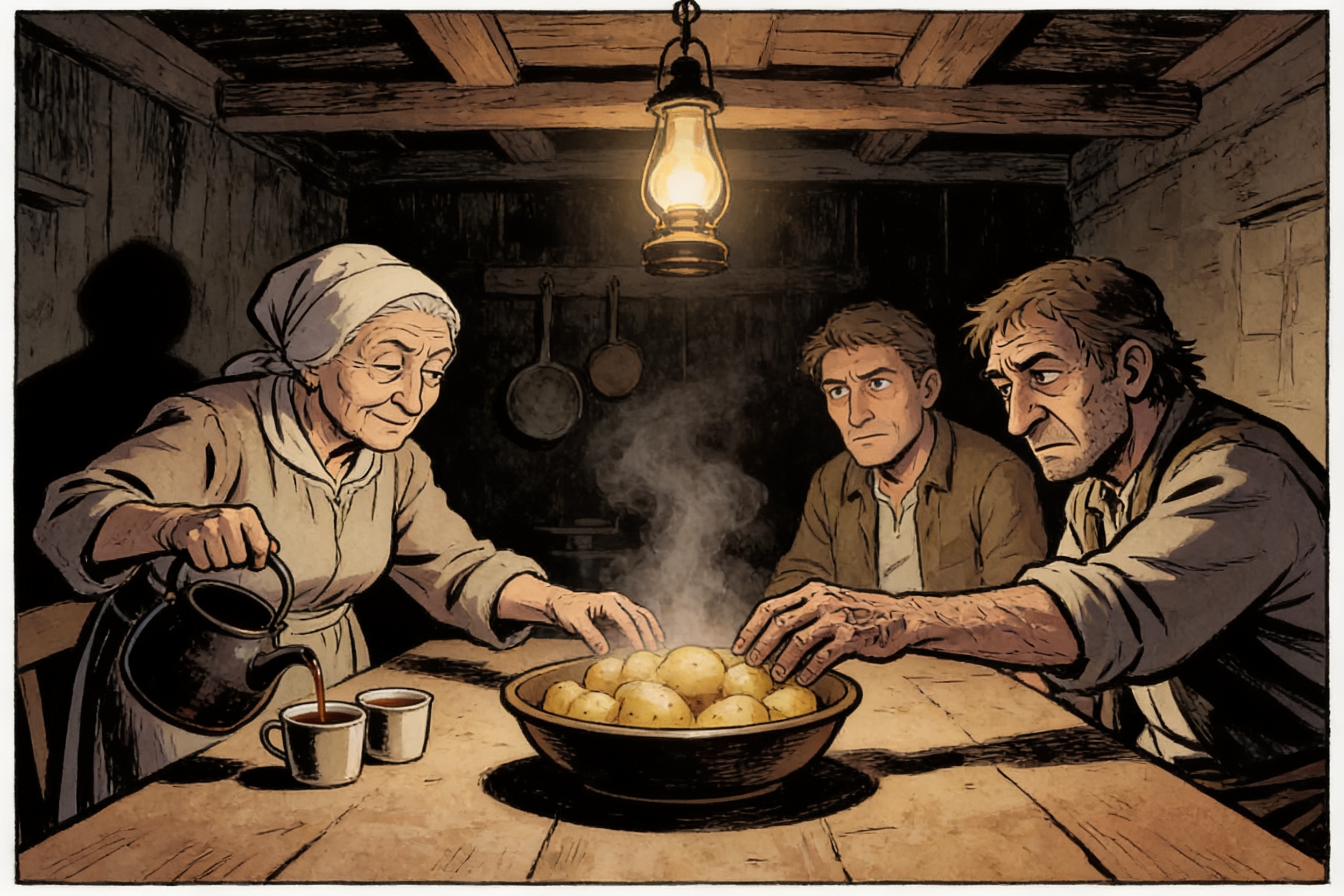
I have wanted to make it clear that people, who, eating their potatoes under the lamplight, have dug the earth with those very hands they use to eat, and so it speaks of manual labor and how they have honestly earned their food.
Vincent van Gogh — Letter to Theo van Gogh, 1885
Technically, the brushwork of this stage is heavy and marked, applying paint in thick layers that accentuate the roughness of the surfaces. However, it still lacked the luminosity and fluency that would define his artistic maturity.
The Impact of Paris: Impressionist Light and Color
In March 1886, Van Gogh moved to Paris to live with his brother Theo, an art dealer. This move radically transformed his visual perception. Upon coming into direct contact with the Impressionists (such as Claude Monet and Camille Pissarro) and the Neo-Impressionists (Georges Seurat and Paul Signac), he discovered modern color theory and the decomposition of light.
- Retinal Optical Mixing
- Integration of pure pigments in the fovea
- Stroke Density
- Low (Strokes)
- Color stroke density
- Blue + Yellow
- Red + Cyan
- Green + Magenta
- Perceived Phase
- Isolated dots
- Average Retinal Sum
- Luminous neutral gray
- At low density, the retina distinguishes pure pigments. As density increases, photoreceptors average contiguous stimuli.
- Low (Contrast)
- Separate pigments
- At low density, the retina distinguishes pure pigments through simultaneous contrast.
- Medium (Vibration)
- Color vibration
- At medium density, edges interact. The retina perceives a chromatic flicker or shimmer.
- High (Fusion)
- At high density, the fovea integrates both tones into a single, more luminous chromatic value.
Nuenen's dark palette dissolved rapidly. Vincent adopted pure, complementary tones, beginning to experiment with pointillism and the juxtaposition of brief strokes of pure color to generate luminosity in the viewer's retina.
- 1886 · Impressionist Contact
Brightens his palette by studying the works of Monet and Degas; abandons Dutch earthy monochromacy.
- 1887 · Discovery of Ukiyo-e
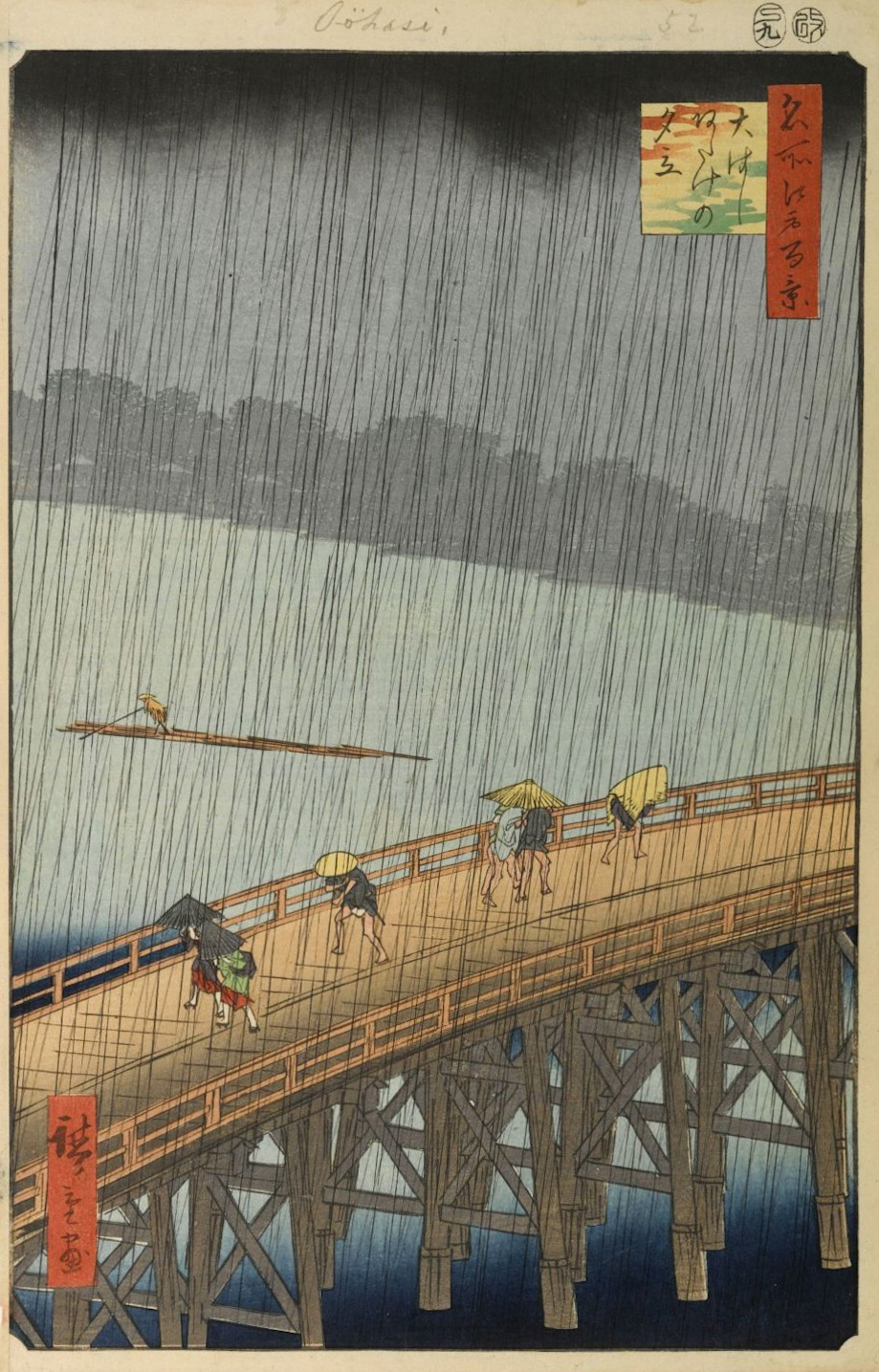
Collects and copies Japanese prints; adopts bold framing, marked outlines, and flat planes of color.
- 1887 · Neo-Impressionist Experimentation
Applies divisional touches of brush alongside Signac on the banks of the Seine.
Added to this chromatic metamorphosis was a fascination with Japanese woodblock prints (Ukiyo-e). Van Gogh admired formal simplification, elevated viewpoints, well-defined black outlines, and the absence of traditional perspective shadows.
| Technical Element | Dutch Period (1880-1885) | Parisian Period (1886-1887) |
|---|---|---|
| Color Gamut | Earths, blacks, dark ochres | Pure colors, primaries, and complementaries |
| Brushwork | Impastoed, opaque, continuous | Brief, divided, direct strokes |
| Influences | Social realism, Rembrandt | Impressionism, Neo-Impressionism, Ukiyo-e |
| Light | Dramatic interior chiaroscuro | Direct sunlight and retinal vibration |
Toward the end of his stay in Paris, Vincent had assimilated the avant-gardes of his time, but sought an even more visceral and individual expression. He needed the radiant light of the south to consolidate his own language.
The Solar Explosion in Arles
In February 1888, Van Gogh settled in Arles, in Provence. Attracted by the intensity of the Mediterranean light, he experienced a period of extraordinary productivity in which he developed his mature and unmistakable style.
In Arles, color ceased to be a naturalistic imitation of reality to become a symbolic and emotional tool. He frequently employed the contrast between complementaries—such as cobalt blue and chrome yellow—to make the surface of the canvas vibrate.
- Arles Palette: Complementary Contrast
- Select Van Gogh's base pigment to examine the optical vibration of the opposite parity.
- Base pigment selection
- Cobalt blue
- Chrome yellow
- ARLES
- Juxtaposition brushwork
- Complementary pair
- Blue / Orange
- Perceived effect
- Luminosity and pulse
- Cobalt blue enhances the warmth of chrome orange. Van Gogh placed pure strokes side by side so that the blending occurred in the viewer's retina.
What is impasto in Van Gogh's painting?
It is the application of very thick oil paint, straight from the tube or with a palette knife, leaving visible relief and tactile marks on the canvas that capture real light.
During the preparation of the Yellow House for Paul Gauguin's arrival, he painted the famous series of «Sunflowers» (Zonnebloemen, 1888). In these works, he executed an experiment in relative monochromacy, exploring almost all possible variations of the chrome yellow pigment.
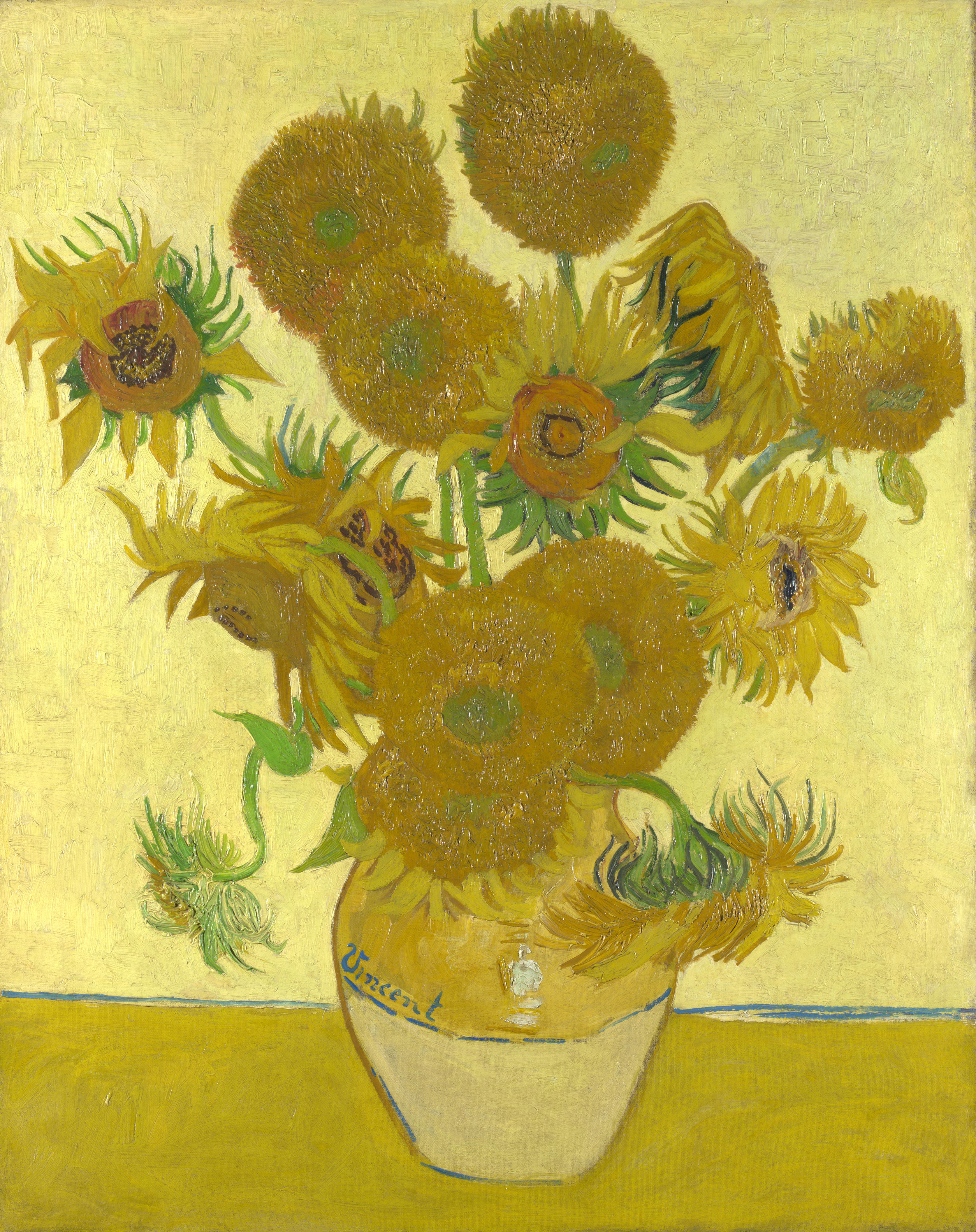
In the hope of living in a studio of our own with Gauguin, I’d like to make a decoration for the studio. NOTHING BUT LARGE SUNFLOWERS.
Vincent van Gogh — Letter to Theo van Gogh, 1888
Brushwork in Arles became thick, rapid, and rhythmic. The pictorial matter accumulated in layers so dense that the flowers and landscapes acquired an almost sculptural three-dimensional presence.
The Refuge of Saint-Rémy and Expressive Dynamism
Following the nervous breakdown that culminated in the mutilation of his ear and Gauguin's departure, Van Gogh voluntarily entered the asylum of Saint-Paul-de-Mausole in Saint-Rémy-de-Provence in May 1889. Despite severe mental health episodes, this period was prolific and technically revolutionary.
In Saint-Rémy, the straight line almost completely disappeared from his work. The straight, energetic brushstrokes of Arles transformed into undulating paths, rhythmic spirals, and swirling contours projecting intense internal agitation.
His masterwork of this era, «The Starry Night» (De sterrennacht, June 1889), shows a nocturnal vision of the sky dominated by celestial whirlwinds.
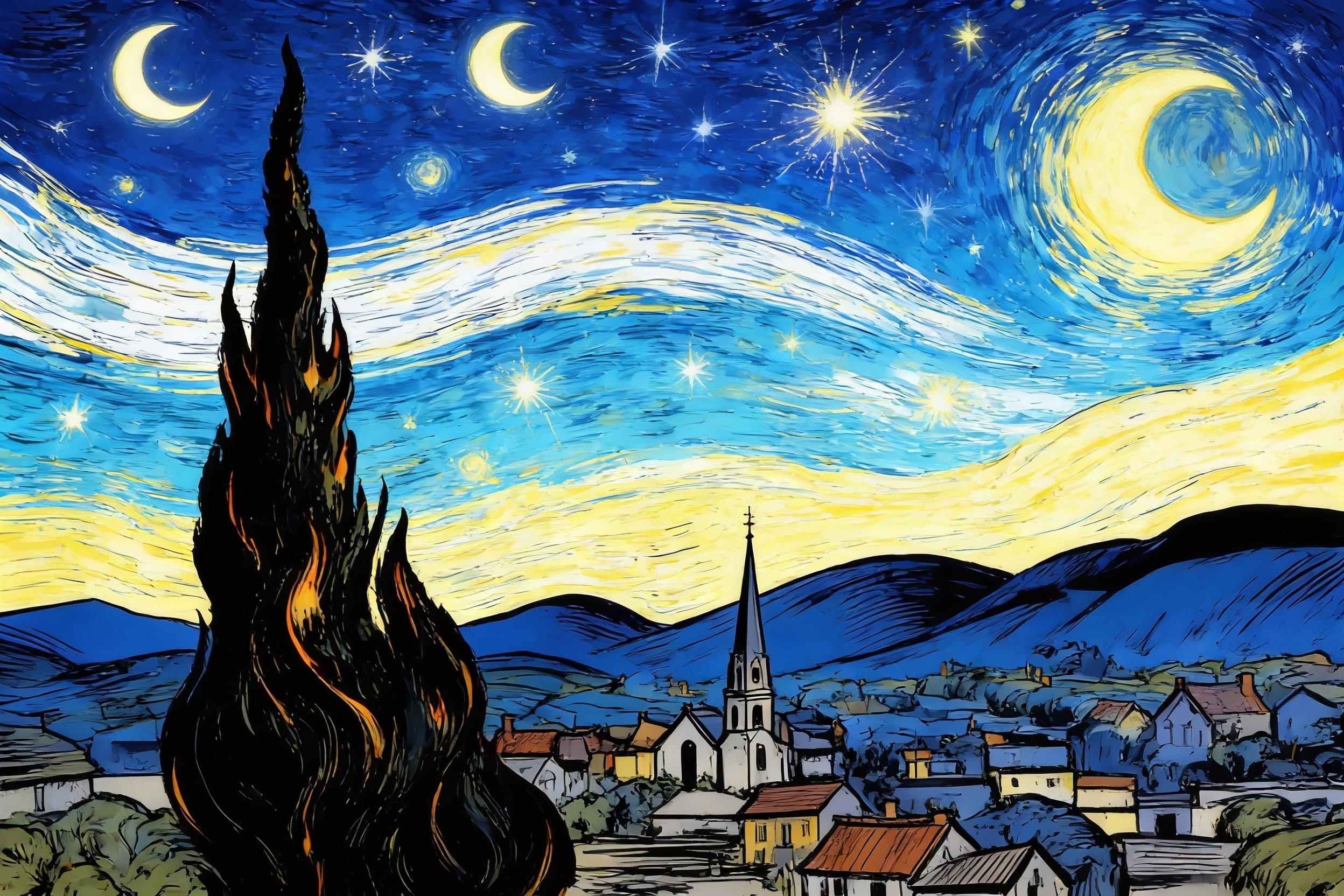
The composition uses the dark cypress in the foreground to connect the terrestrial strip with the immensity of the firmament, creating a constant contrast between cool blues and yellow stars surrounded by halos of light.
- Fluid Dynamics in The Starry Night
- Simulation of the Kolmogorov scale in the turbulent flow of brushstrokes
- Turbulence 5s
- Energetic vortices transferring energy in a cascade, reflecting real fluid mathematics.
The Last Days in Auvers-sur-Oise
In May 1890, Van Gogh moved to Auvers-sur-Oise, a town north of Paris, to be close to his brother Theo and under the care of Dr. Paul Gachet. In his last 70 days of life, he painted more than 70 canvases at a frantic pace.
The works of Auvers show a dramatic tension at the limit. His panoramic landscapes of wheat fields under stormy skies employ an elongated horizontal format that emphasizes the loneliness and immensity of the surroundings.
In «Wheat Field with Crows» (Korenveld met kraaien, July 1890), paths leading nowhere, a flock of black birds, and violent brushstrokes express an intense dramatic charge.
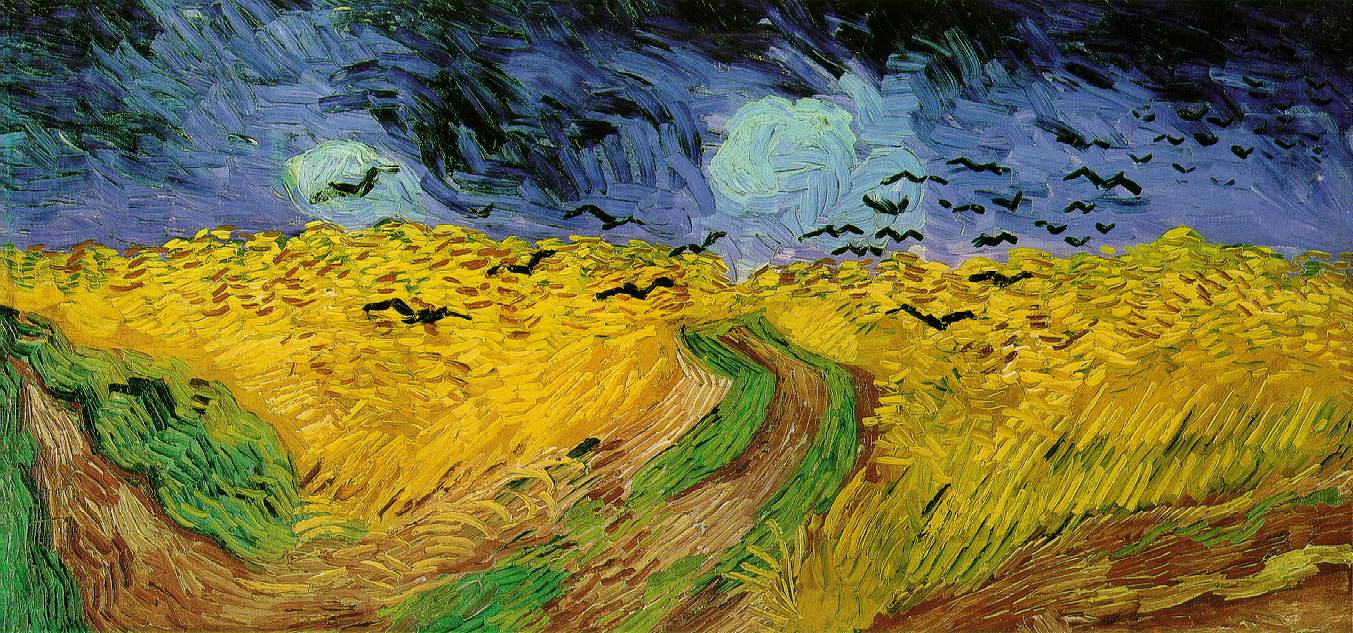
They are vast fields of wheat under turbulent skies, and I did not hesitate to try to express sadness and extreme loneliness.
Vincent van Gogh — Letter to Theo van Gogh, July 1890
Van Gogh passed away on July 29, 1890. Although he sold very few paintings during his lifetime, his technical audacity, the expressive liberation of color, and the use of tactile impasto laid the foundations of expressionism and 20th-century modern art.