

Trigger heights and who decides
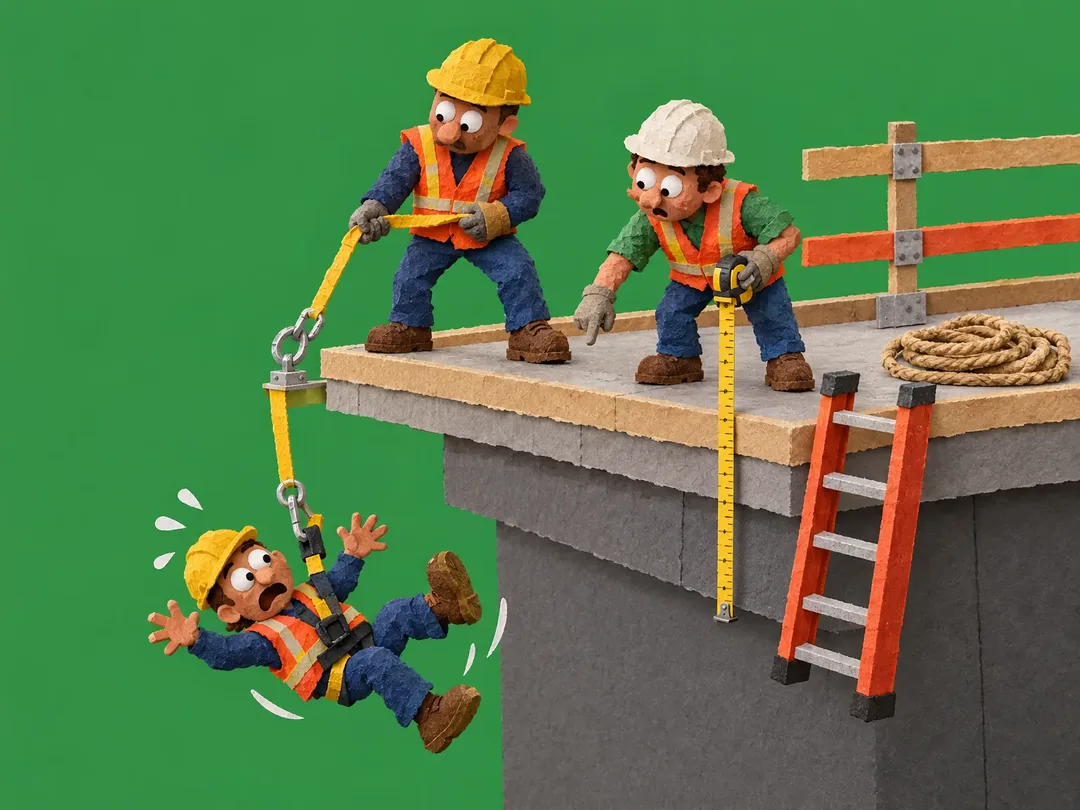
Picture a second-floor deck with no railing yet. The drop to the dirt is about seven feet, and you could almost jump it. That is exactly the kind of edge OSHA writes rules about. In construction, your employer generally must provide fall protection once you are exposed to a fall of 6 feet or more to a lower level. A "lower level" means anything you could land on, including the ground, a floor below, a pile of material, an excavation or a piece of equipment.
Six feet is the general number, and a few cases move the line. On scaffolds, the trigger is more than 10 feet above a lower level, because scaffold rules live in their own section of the standard, Subpart L. Some hazards have no minimum height at all. If you work above dangerous equipment, such as open gears, drive belts or vats of acid, Subpart M requires protection regardless of how high you stand.
Keeping you from falling versus catching you
Fall protection comes in two families. Prevention systems keep you away from the edge in the first place. A guardrail does this, and so does a fall restraint system, which is a harness and lanyard short enough that you physically cannot reach the edge even if you slip and slide. Arrest systems let the fall begin and then stop it before you hit anything below. A personal fall arrest system, made of an anchor, a full-body harness and a lanyard or lifeline, works this way.
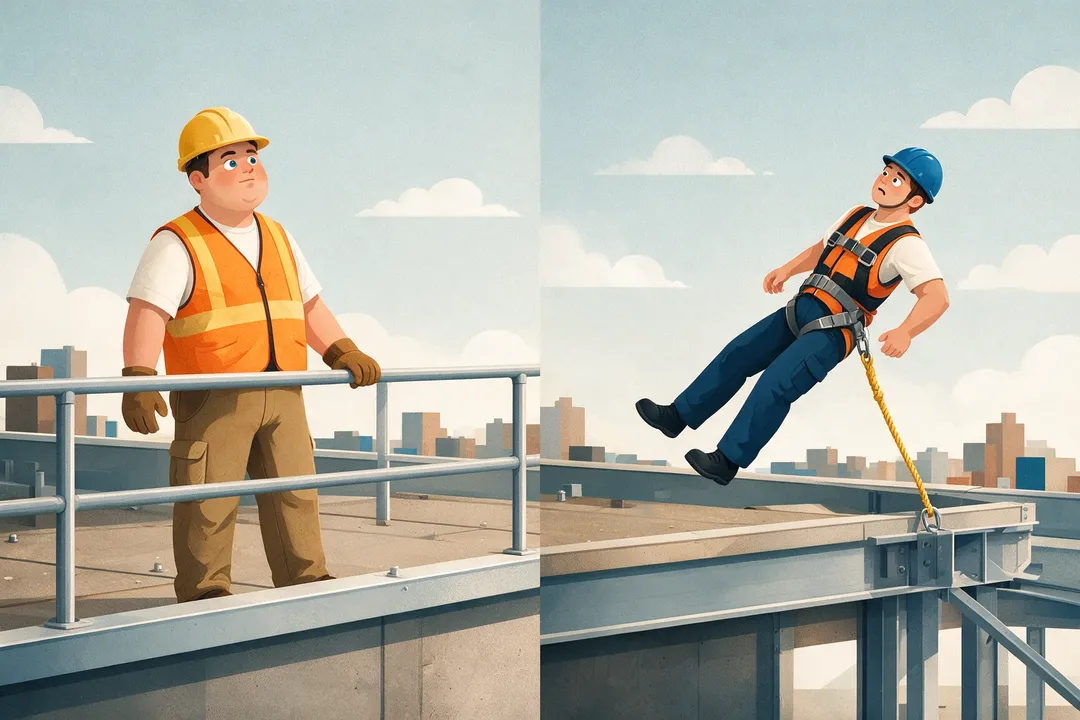
Prevention is the better bet whenever it is possible, because a worker who never leaves the deck never gets jerked to a stop or left hanging. Arrest systems take over where a railing cannot go, such as a leading edge where the floor is still being built.
Who picks the system
Your employer chooses the fall protection and has to supply it, train you on it and make sure it gets used. OSHA presumes that conventional protection, meaning guardrails, nets or personal fall arrest, is feasible on almost every job, and only a few situations allow a written site-specific fall protection plan instead. Training must come from a competent person, someone who can recognize hazards and has the authority to fix them, and it must cover how to inspect, set up and maintain the equipment you will use.

Three workers start their shifts on the same commercial job. One frames a floor edge 7 feet above a slab, one stands on a scaffold platform 8 feet up, and one works 4 feet above an open vat of acid.
Inspecting and fitting a personal fall arrest system
OSHA trainers teach the arrest system as the ABCs, which stand for Anchorage, Body harness and Components, the connectors, lanyards, lifelines and deceleration devices that tie it together. Every one of those parts must be inspected before each use, and anything worn or damaged comes out of service. A harness that has already caught a fall also goes out of service until a competent person inspects it and clears it for reuse.
The two-minute harness check
Hold the harness up by the back D-ring and let it hang so the straps fall into place. Then work through it with your hands, not just your eyes.
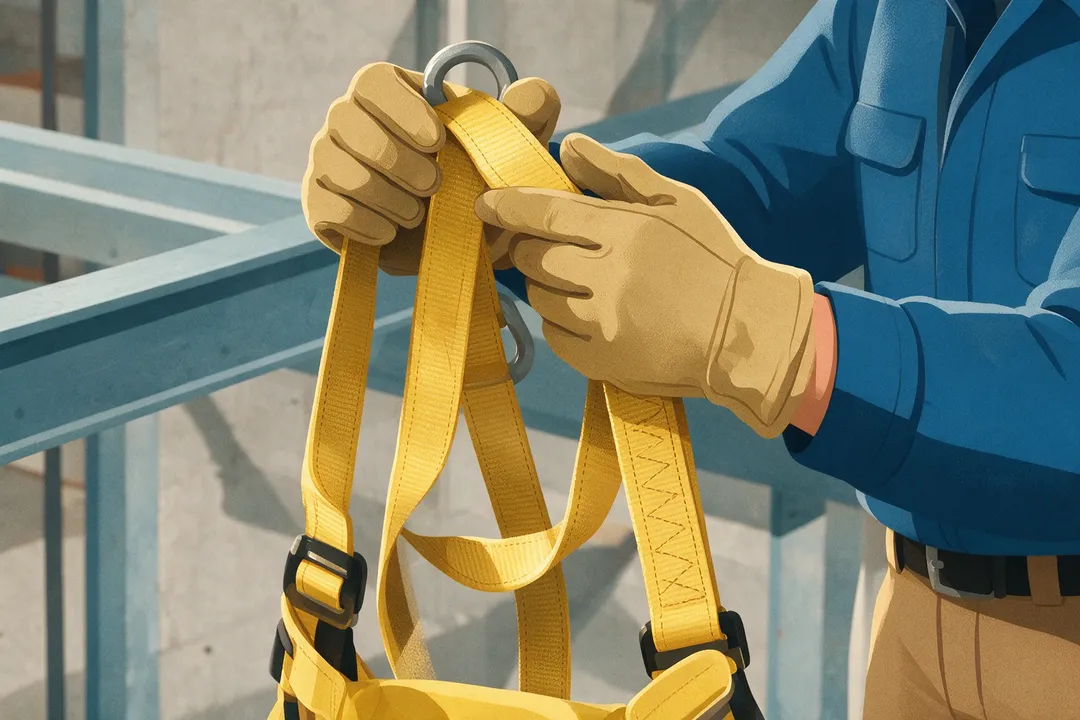
- Run every inch of webbing through your fingers, feeling for cuts, frayed edges, burns, paint, chemical stains or stiff spots.
- Look at the stitching for pulled or broken threads.
- Check buckles and D-rings for cracks, rust, bending or sharp edges.
- On the lanyard, look for a torn shock-absorber pack and make sure snaphooks lock. Non-locking snaphooks have been banned in arrest systems since 1998.
Putting it on right
A harness only works if it fits snugly. The back D-ring should sit centered between your shoulder blades, and the leg straps get tightened until they are snug. Loose leg straps let your body slide during a fall, and the straps can end up where you really do not want them.
You will still see old body belts around some shops. Since January 1, 1998, OSHA has prohibited body belts in personal fall arrest systems because a belt around the waist concentrates the whole stopping force on your midsection and can cause serious internal injury. A belt is still allowed for restraint or for positioning work that limits a free fall to 2 feet./
What the anchor has to hold
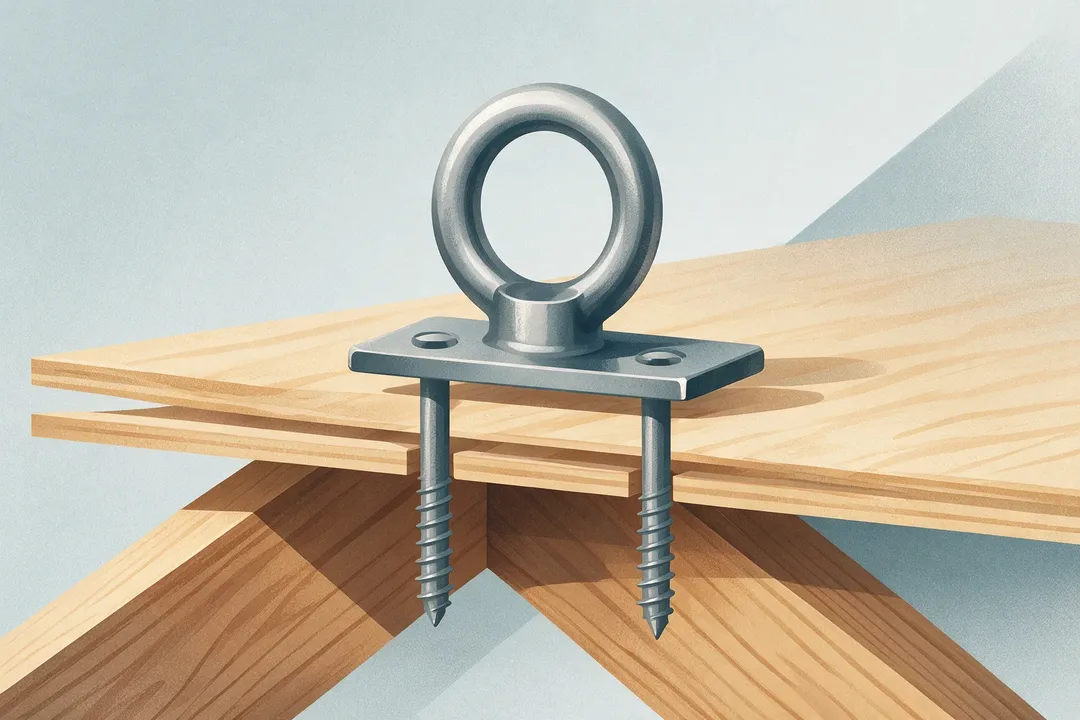
The anchorage must support 5,000 pounds per worker attached, or be designed and used under a qualified person's supervision as part of a system with a safety factor of at least two. That number surprises people until they realize that a falling body creates far more force than its weight. On a roof, a nail through the sheathing will not hold that, nor will a single truss or most guardrails, so roofers drive the anchor's fasteners through the sheathing into the rafter or truss below.
Doing the clearance math
The system must keep you from free falling more than 6 feet and from touching any lower level, and it can stretch at most 3.5 feet while slowing you down. To check that you will not hit the ground, add up the total fall clearance.
| Piece of the fall | Typical distance |
|---|---|
| Free fall (lanyard length) | 6 ft |
| Deceleration distance | 3.5 ft |
| D-ring shift and harness stretch | 1 ft |
| Back D-ring height above your boots | 5 ft |
| Safety margin | 2 ft |
| Total clearance needed below the anchor | 17.5 ft |
So a worker tied off at foot level on a 12-foot-high deck with that lanyard would hit the ground before the system finished stopping him. On low work, a self-retracting lifeline, which locks within a couple of feet, is often the only setup that actually fits.
- Elevation blueprint of a worker tied off below an anchor with clearance brackets
- ft
- System type
- Fall clearance below the anchor
- Total clearance needed
- 6 ft shock lanyard
- 3 ft SRL
- Deck height
- Free fall
- Decel.
- Stretch
- D-ring to boots
- Margin
- Anchor
- Lower level
- Clears the lower level
- Worker strikes the lower level
Lifelines, swing falls, and the rescue plan
A lifeline is the rope or cable you clip your lanyard into, and its direction changes how it behaves. A vertical lifeline hangs straight down from an anchor above you, and you move up and down it with a rope grab. It must have a breaking strength of at least 5,000 pounds and be protected from being cut or rubbed through on sharp edges. A horizontal lifeline stretches between two anchors so you can walk along a beam or roof edge while staying connected. On scaffolds, lifelines must be independent of the ropes holding the platform up and cannot share their anchorage point.
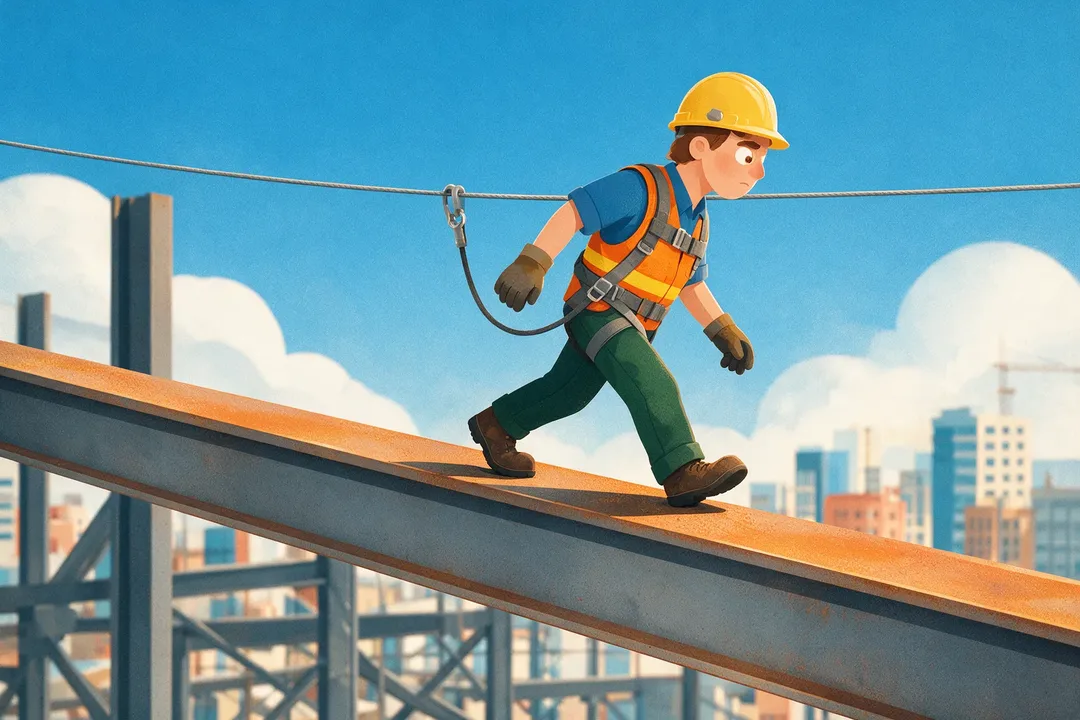
Self-retracting lifelines work like a seatbelt reel. The line pays out and pulls back as you move, then locks when it senses a sudden pull. Units that limit free fall to 2 feet or less must sustain at least 3,000 pounds, and ones that allow longer falls must sustain 5,000 pounds.

The swing you did not plan for
If your anchor sits off to the side instead of straight above you, a fall turns into a pendulum. You drop, then swing sideways into a wall, a column or the corner of a building, and the swing can also add to the distance you fall. OSHA tells employers to evaluate this pendulum effect and to place the anchor above the work area, up the roof slope from the worker, with a maximum side-to-side work range set by the manufacturer. The farther you drift sideways from your anchor, the harder you swing.
- Cross-section of a roof edge and wall showing a worker swinging like a pendulum from an offset anchor
- Anchor
- Offset
- Extra drop
- Wall
- Offset anchor
- ft
- Roof
Hanging is not the end of the emergency
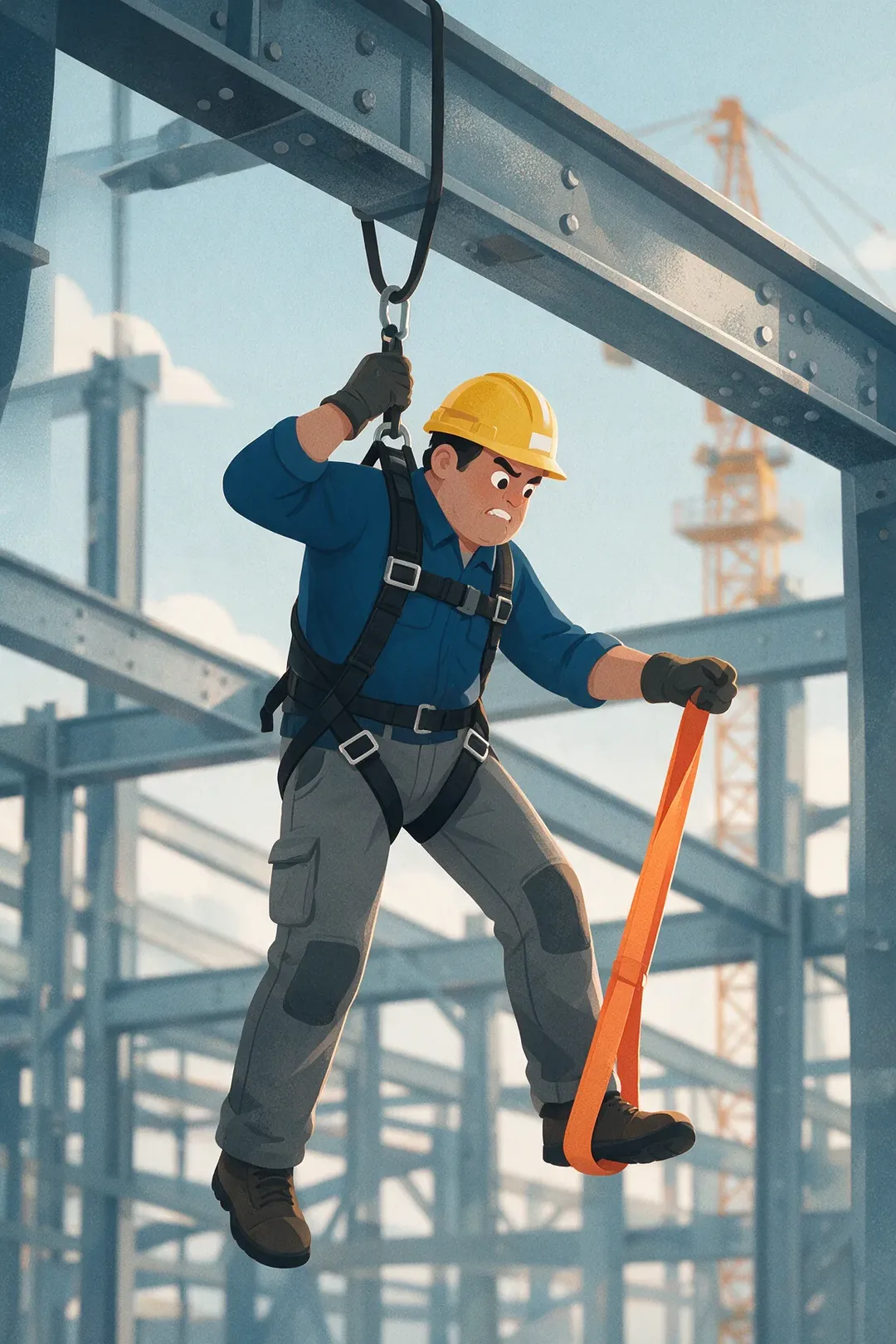
A harness that catches you has done half its job. A worker left hanging upright with leg straps pressing on the thighs can have blood pool in the legs, and that can make him pass out and, given enough time, die. Trainers call this suspension trauma. That is why OSHA requires the employer to provide for prompt rescue of anyone who falls, or to make sure workers can rescue themselves.
Prompt rescue has to be planned before anyone ties off. Calling 911 and waiting is not a plan, because a fire crew may take many minutes to arrive and may not carry the gear to reach someone dangling from the fourth floor of an open steel frame. A real plan names who brings the worker down, with what equipment, such as a lift, a ladder or a rescue kit, and how fast. Many harnesses now carry trauma relief straps, loops a hanging worker can step into to take pressure off his legs while help arrives.
Guardrails and safety nets
A guardrail is the simplest fall protection on site, and it works whether you remember it or not. A standard guardrail has three parts. The top rail sits about 42 inches above the walking surface, plus or minus 3 inches, which is the same 42 inches OSHA requires on unprotected stair landings. The midrail runs about halfway between the top rail and the floor to stop someone from sliding under. The toeboard is a board along the floor that keeps tools and debris from being kicked off the edge onto people below.
Each part has a strength test. The top rail must withstand 200 pounds pushed outward or downward at any point. Midrails, screens and other in-between members must withstand 150 pounds. Toeboards must stand at least 3.5 inches tall, resist 50 pounds, and leave no more than a quarter inch of gap at the floor. The rails also need smooth surfaces so they do not puncture hands or snag clothing.

Guardrail versus handrail
A handrail is something you grip as you climb stairs, and it sits lower. On a construction stairway, a stair rail used as a handrail runs between 36 and 37 inches above the tread. A guardrail at 42 inches is built to stop a body from going over, not to guide a hand. Leaning a full load of drywall against a stair handrail and expecting it to act like a guardrail asks it to do a job it was never sized for.
Safety nets
Nets catch you after the fall starts, so they belong in the arrest family. Crews use them where workers cannot reasonably wear a harness or where a guardrail would block the work, for example on bridge decks or high open steel. A net has to hang as close as practical under the work surface, and under OSHA's net rules it can never be more than 30 feet below. Before use, and again after it is moved or repaired, the installed net is drop-tested, typically with a 400-pound bag of sand, and a competent person inspects it at least weekly and after anything that could damage it. Anything that falls into the net, like scrap or tools, gets cleared out quickly so it does not hurt the next person who lands there.


Portable ladders and the 4-to-1 setup
Ladders look harmless, which is part of why they rank near the top of OSHA's citations. In a year of roofing contractor inspections, ladder safety came in second, right behind the duty to provide fall protection. Most ladder falls trace back to setup and habits, not broken equipment.
Pick the right ladder
Start with the job. A stepladder stands on its own and works for indoor tasks at moderate height. An extension ladder leans against a wall or edge and is the usual way onto a roof. Single-rail ladders are banned outright. Before climbing, check the rungs, rails and feet, because a competent person must inspect ladders for visible defects periodically and after anything that could affect safe use.
The 4-to-1 rule
Set an extension ladder so the base sits one foot out from the wall for every four feet of working length, measured along the ladder up to the top support. For a ladder touching a gutter 16 feet up its length, the feet go 4 feet out. A quick field check is to stand at the base with your toes against the rails and stretch your arms straight out. If your palms reach the rungs, you are close. Set it steeper and the ladder can tip back, while setting it flatter lets the feet kick out.
When the ladder is how you reach a roof or landing, the side rails must extend at least 3 feet above that upper surface, so you have something to hold while stepping on and off. If the ladder is too short to stick up 3 feet, it must be secured at the top and a grab rail added.
- Elevation view of a two-story wall with an extension ladder leaning on the gutter
- Base distance from wall
- ft
- Base distance from wall in feet
- Tip-back hazard: too steep
- Safe 4-to-1 setup
- Slip-out hazard: too flat
Climbing habits that keep you alive
Keep three points of contact, meaning two hands and a foot or two feet and a hand, every second you are going up or down. Face the ladder. Do not carry anything that could throw off your balance, and haul tools up in a bucket on a rope instead.
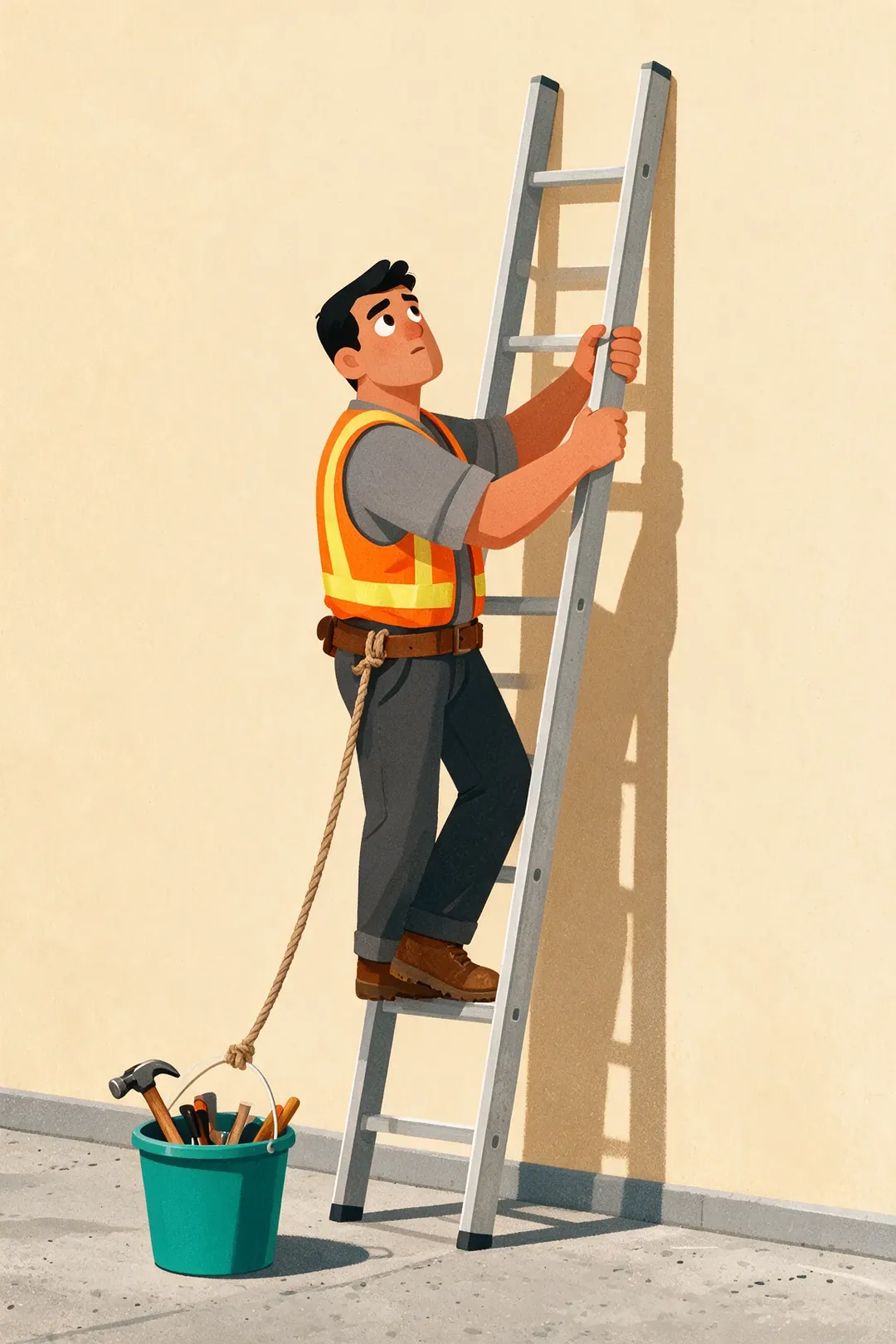
The lethal mistakes repeat on every jobsite. Workers overreach to the side instead of climbing down and moving the ladder, which shifts their weight past the rails. They carry a bundle of shingles on one shoulder, which leaves one hand free and none to catch themselves. On stepladders they stand on the top cap or the top step, which OSHA prohibits, and they use the ladder folded and leaned against a wall instead of fully open.
Spotting an unsafe scaffold
On a scaffold, fall protection kicks in once you are more than 10 feet above a lower level, and the usual answer is a guardrail on all open sides and ends. For scaffolds built after January 1, 2000, the top rail sits between 38 and 45 inches above the platform, and the midrail goes roughly halfway down. Some scaffolds, like single-point and two-point suspension scaffolds, need both a guardrail and a personal fall arrest system.
You can learn a lot about a scaffold before you set foot on it. Start at the ground and work up.
- Footing. Every leg should rest on a base plate, and each base plate on a mudsill, a solid wood plank that spreads the load over soft ground. Legs sitting on cinder blocks, bricks or loose dirt are a red flag.
- Bracing and ties. A supported scaffold taller than four times its base width must be tied, guyed or braced to the structure so it cannot tip.
- Platform. The deck must be fully planked or decked, with no gaps you could step through.
- Access. If the platform is more than 2 feet above or below where you get on, there has to be a ladder, stair tower or ramp, and climbing the cross braces is prohibited.
- Surface. Nobody works on a scaffold covered in snow, ice or anything slippery except to clean it off.

Looking at it versus inspecting it
Glancing up and deciding the scaffold looks fine is not an inspection. OSHA requires a competent person to inspect the scaffold and its components for visible defects before each work shift and after anything that could weaken it, such as a truck clipping a leg or a storm. A competent person is someone who can identify existing and predictable hazards and who has the authority to fix them on the spot. Many sites mark the result with a tag at the access point, green for ready, yellow for use with conditions and red for do not use. If the tag is missing or red, stay off and tell your supervisor.

Working on steep and low-slope roofs
Before anyone climbs onto a roof, the crew needs to know its pitch, because the rules change with it. A low-slope roof rises 4 inches or less for every 12 inches of run, and anything steeper counts as a steep roof. On a steep roof with an edge 6 feet or more above the ground, workers need guardrails with toeboards, safety nets or personal fall arrest. You cannot walk a 6-in-12 shingle roof safely behind a rope line, so tie-off is the norm there.
Warning lines and safety monitors on low-slope roofs
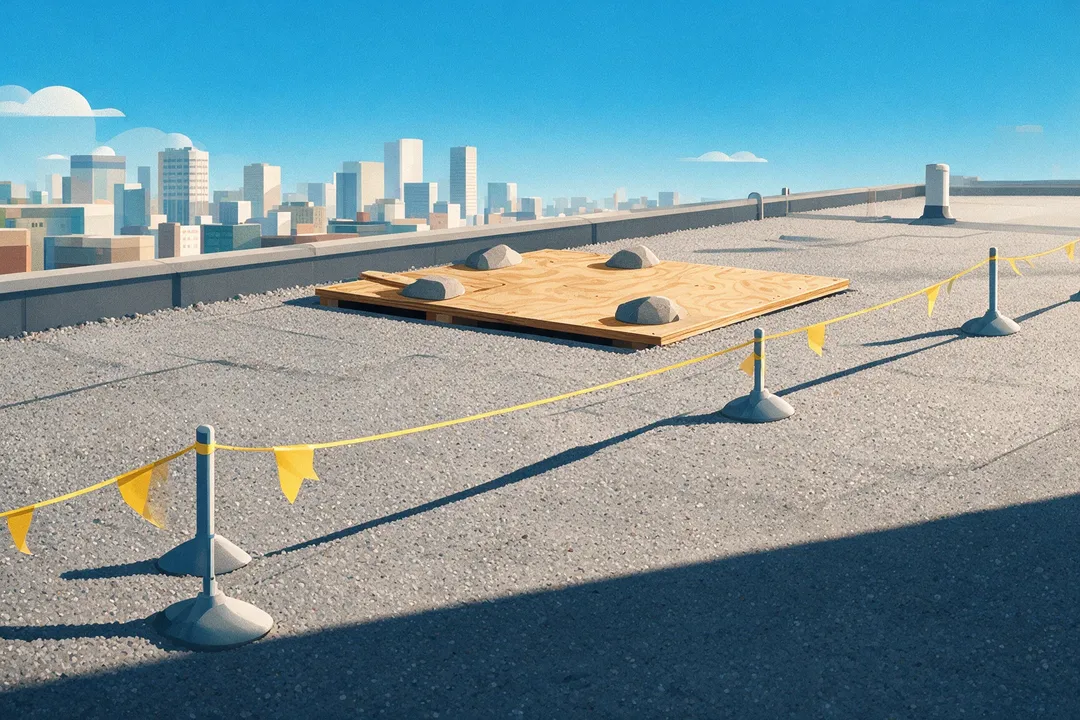
Low-slope roofs allow a few more options, including a warning line combined with another system or a warning line with a safety monitor. A warning line is a rope, wire or chain on stanchions that marks the zone where roofing happens. It must stand at least 6 feet back from the roof edge, or 10 feet when mechanical equipment like a roofing kettle cart runs perpendicular to the edge. The line hangs between 34 and 39 inches above the surface, is flagged with high-visibility material at least every 6 feet, and has a tensile strength of at least 500 pounds.
A safety monitor is a competent person whose only job is to watch the crew and warn anyone who gets close to the edge. The monitor stands on the same roof, within speaking distance, and has no other duties. On roofs 50 feet wide or less, a safety monitor alone is allowed.
Skylights and holes
A skylight looks like part of the roof, and workers sit on them, step back onto them and set materials on them. Plastic domes and older skylights can shatter under a person's weight. Each one needs a cover, a guardrail around it or a personal fall arrest system. A cover must hold at least twice the weight of the workers, equipment and materials that could be on it at once, and it gets secured so wind or a boot cannot slide it away. Crews also mark covers with "HOLE" or "COVER" so nobody picks one up to use as scrap plywood.
When the protection is not there
Sometimes you will reach the top of the ladder and find an open edge, no anchors and no lines. The safe move is to stop, stay off the roof and report it to your supervisor. Your employer has the legal duty to provide fall protection before you are exposed, and the job waits until it is in place. A delayed roof costs a day of work, while a fall from it can cost a life.
Sources
References
- Protecting Roofing Workers — pp. 8, 10, 11, 12, 14, 15, 16, 17, 19, 21
- Stairways and Ladders: A Guide to OSHA Rules — pp. 5, 9
- Fall Protection in Construction — pp. 7, 8, 10, 16, 18, 20, 24, 27, 28, 33, 36, 38
- A Guide to Scaffold Use in the Construction Industry — pp. 6, 12
Audiovisual sources
- Construction worker wearing a personal fall arrest harness near an unprotected roof edge — ehscareers.com
- Worker in hard hat and vest climbs an orange extension ladder against a concrete wall, with a second folded ladder and scaffolding nearby. — fieldsafetytalk.com
- Multi-level supported scaffold on a commercial construction site under OSHA 1926 Subpart L — ehscareers.com
- Diagram of OSHA 1910.28 low-slope roof work zones showing protection requirements under 6 feet, 6 to 15 feet, and 15 feet or more from the roof edge — standingseamroofanchor.com
Frequently asked questions
At what height does OSHA require fall protection in construction?
In construction, your employer generally must provide fall protection once you are exposed to a fall of 6 feet or more to a lower level. A lower level means anything you could land on, including the ground, a floor below, a pile of material, an excavation or a piece of equipment.
How high can you work on a scaffold before fall protection is required?
On scaffolds, the trigger is more than 10 feet above a lower level, because scaffold rules live in their own section of the standard, Subpart L. The general 6-foot rule applies to most other construction surfaces.
What is the difference between fall prevention and fall arrest?
Prevention systems keep you away from the edge in the first place, like a guardrail or a fall restraint system short enough that you cannot reach the edge. Arrest systems let the fall begin and then stop it before you hit anything below, using an anchor, a full-body harness and a lanyard or lifeline.
How much fall clearance does a 6-foot shock-absorbing lanyard need?
With a 6-foot shock-absorbing lanyard, total clearance needed below the anchor is 17.5 feet. That adds 6 feet of free fall, 3.5 feet of deceleration distance, 1 foot of D-ring shift and harness stretch, 5 feet of back D-ring height above your boots, and a 2-foot safety margin.
How much weight must a fall protection anchor hold?
The anchorage must support 5,000 pounds per worker attached, or be designed and used under a qualified person's supervision as part of a system with a safety factor of at least two. On a roof, a nail through the sheathing will not hold that, so roofers drive the anchor's fasteners through the sheathing into the rafter or truss below.