
A Giant in the Harland and Wolff Shipyards
A Giant in the Harland and Wolff Shipyards
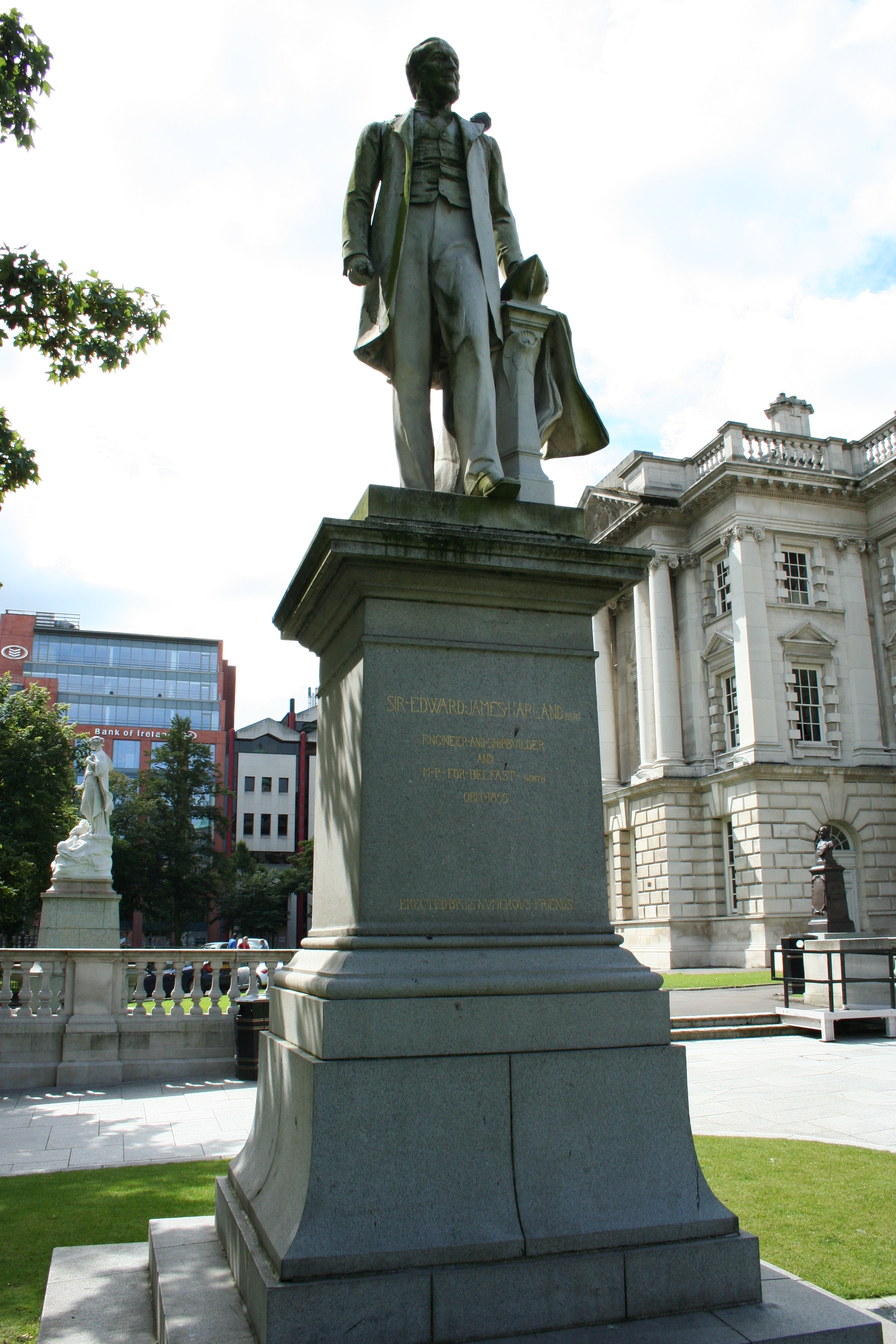
The story of the RMS Titanic begins not in the icy waters of the North Atlantic, but in the gritty, smoke-filled shipyards of Belfast. It was here, at Harland and Wolff, that the White Star Line sought to answer a rival's challenge with steel, rivets, and audacious ambition.
In the early 20th century, transatlantic travel was the ultimate status symbol of speed. The Cunard Line had just launched the Lusitania and the Mauretania, sleek greyhounds that captured the Blue Riband for the fastest crossing. Rather than compete on speed, White Star Line's managing director, J. Bruce Ismay, chose a different battlefield: sheer size and unparalleled luxury. The goal was not to cross faster, but to cross in a floating palace.
The commission was given to Harland and Wolff, White Star's long-time builder. The shipyard, located on Queen's Island in Belfast, was one of the largest and most advanced in the world. The project was monumental, requiring the construction of two sister ships, the Olympic and the Titanic, with a third, the Britannic, to follow. The Titanic was assigned yard number 401.
The scale of the undertaking is hard to grasp. The ship was to be 269.1 meters long, with a beam of 28.2 meters. To build this floating city, the shipyard used over 2,000 steel plates, each 2.5 to 3.8 centimeters thick, which were riveted together with more than three million rivets. These weren't just numbers; they represented the physical labor of thousands of men, working in dangerous conditions, to forge a hull that would displace 52,310 tons of water.
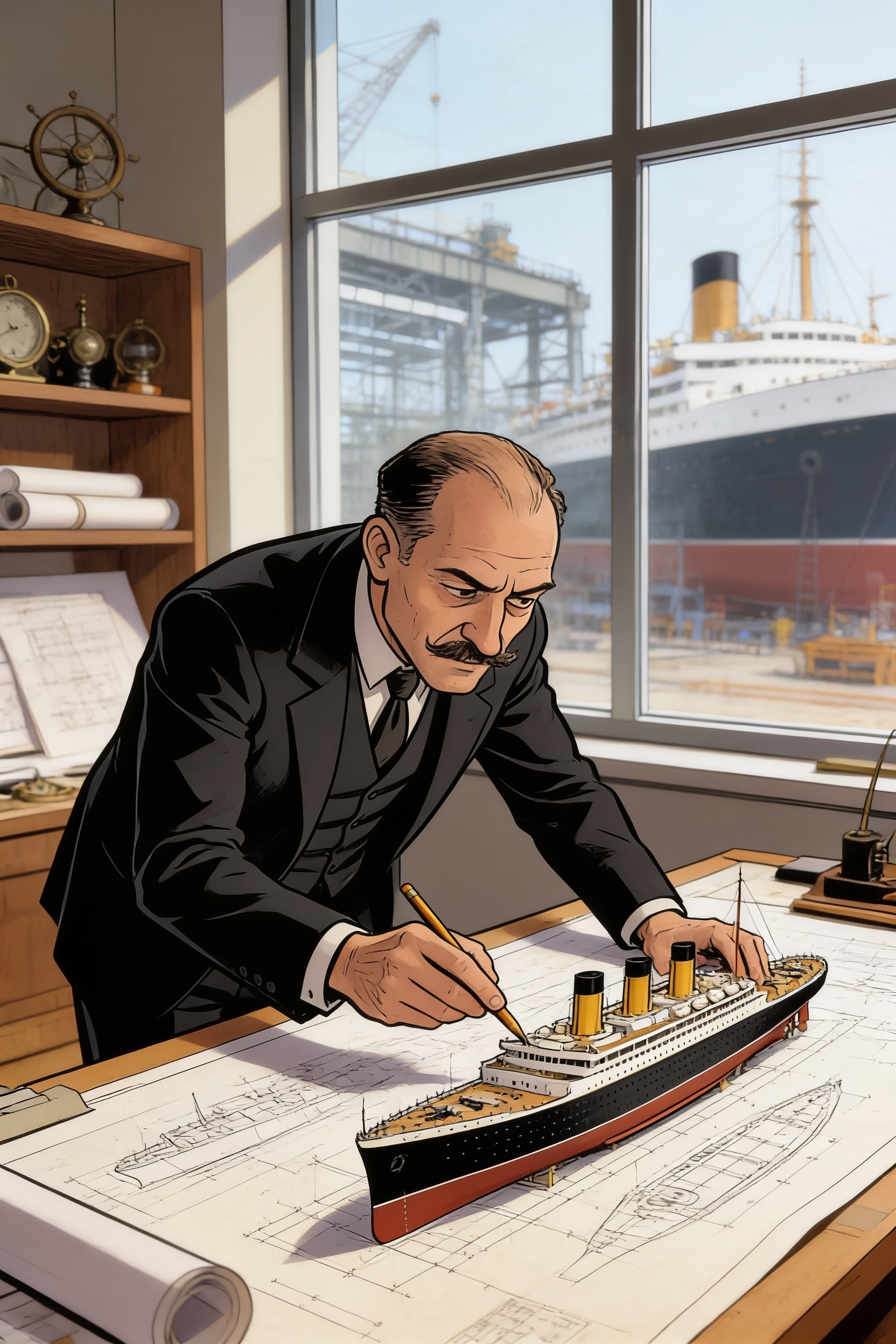
The design was a collaborative effort, led by the shipyard's chief naval architect, Thomas Andrews, and the company's chairman, Lord William Pirrie. Andrews was a meticulous engineer who knew every rivet of his creation. He was also a man who would tragically go down with his ship, a testament to the era's code of honor. The Titanic was not just a ship; it was a statement of industrial might, a monument to an age that believed technology could conquer nature itself.
Architecture and Engineering: Between Luxury and Safety
The Titanic was a marvel of Edwardian engineering, but its design reflected a delicate—and ultimately fatal—balance between opulence and safety. The ship was a floating palace, but its hull concealed a system of watertight compartments that was state-of-the-art for its time, yet fundamentally flawed.
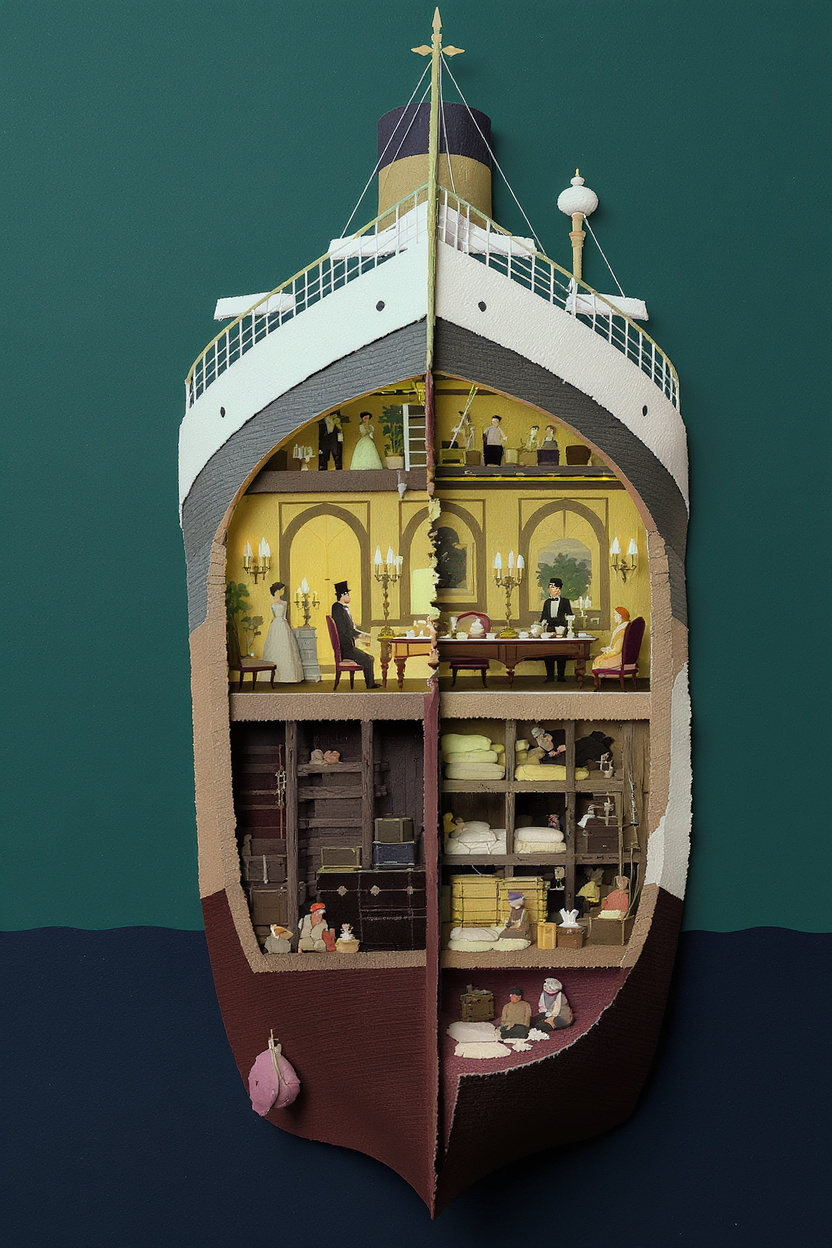
The ship's interior was a showcase of luxury. First-class passengers enjoyed a grand staircase, a gymnasium, a squash court, a Turkish bath, and a swimming pool. The dining saloon was a vast, paneled hall that could seat over 500 people. The goal was to make the crossing an experience in itself, a pleasure cruise rather than a mere voyage. This focus on passenger comfort drove the design, influencing everything from the allocation of space to the placement of lifeboats, which were initially planned to be few, as they were seen as clutter on the decks.
Beneath this opulence lay the ship's safety system: a double bottom and a series of 15 transverse watertight bulkheads that divided the hull into 16 "watertight" compartments. These bulkheads were fitted with doors that could be closed remotely from the bridge. The ship was designed to stay afloat with any two of its central compartments flooded, or with the first four compartments flooded. This led to the popular—and dangerous—belief that the ship was "practically unsinkable."
However, the system had a critical weakness. The watertight bulkheads did not extend all the way up to the top of the hull. They rose only to the level of E Deck, leaving the upper decks open. This meant that if water filled a compartment beyond the height of the bulkhead, it could spill over the top into the adjacent compartment, creating a chain reaction. The ship was designed to survive a collision that would flood a single, or even two, compartments. It was not designed to survive a gash that would flood five of them simultaneously.
- Cascading water across 5 compartments
- Hull cross-section showing water spilling over bulkheads between compartments
- E-deck
- Water spills over bulkheads from left to right when compartments 1–5 are breached.
The engineering was a paradox. It was a ship built with the most advanced safety features of its day, yet those features were designed to handle a predictable accident, not the catastrophic, multi-compartment flooding that an iceberg would inflict. The design was a product of its time, a time when the limits of safety were defined by the imagination of what could go wrong, and the Titanic's designers simply could not imagine the scale of the disaster that awaited.
Preparations and Departure from Southampton
By the spring of 1912, the Titanic was ready. After sea trials near Belfast on April 2, she sailed to Southampton to be provisioned for her maiden voyage. The preparations were a logistical feat, involving hundreds of tons of coal, food, and supplies, as well as the coordination of a crew of nearly 900.
The ship was a microcosm of Edwardian society, a floating representation of its rigid class structure. The passenger list was a stark division of wealth and poverty. In first class were the titans of industry and finance: John Jacob Astor, one of the richest men in America; Benjamin Guggenheim, the mining magnate; and Isidor Straus, co-owner of Macy's department store. They were accompanied by their wives, servants, and mountains of luggage. In second class were professionals, clergymen, and skilled tradesmen seeking new opportunities in America. But the vast majority, over 700 people, were in third class, or steerage—immigrants from Ireland, Scandinavia, and Eastern Europe, hoping for a better life in the New World.
The departure from Southampton on April 10, 1912, was a spectacle. The ship was so large that her suction pulled the New York, a smaller liner moored nearby, from its berth, nearly causing a collision. After a tense moment, the Titanic was underway, heading down the English Channel.
That evening, she made her first stop at Cherbourg, France, to pick up more passengers. Then, on the morning of April 11, she arrived at Queenstown (now Cobh) on the southern coast of Ireland. Here, she took on a final batch of passengers and sacks of mail. At around 1:30 PM, the Titanic raised anchor for the last time and steamed out into the open Atlantic, setting a course for New York. She was carrying over 2,200 souls, and the vast majority of them believed they were on the safest ship ever built.
The First Days in the North Atlantic
The first three days of the voyage were a routine of calm seas and clear skies. The Titanic steamed westward at a brisk pace, her engines a constant, rhythmic thrum. Life on board settled into a comfortable pattern. First-class passengers enjoyed lavish meals and social events, while those in steerage organized their own gatherings in the common rooms.
The ship's bridge was a world of discipline and procedure. Captain Edward Smith, a veteran of the White Star Line and the most senior captain in the fleet, was in command. He was a popular figure, known for his genial manner, and this was to be his final voyage before retirement. The ship was under the command of a skilled crew, but the prevailing culture of the era was one of confidence in the ship's invincibility.
This confidence was tested by a series of warnings. The Titanic was equipped with a powerful Marconi wireless telegraph, a new technology that was transforming maritime communication. The two wireless operators, Jack Phillips and Harold Bride, were employed by the Marconi Company, not the White Star Line. Their job was to send and receive passenger messages, but they also relayed navigational warnings.
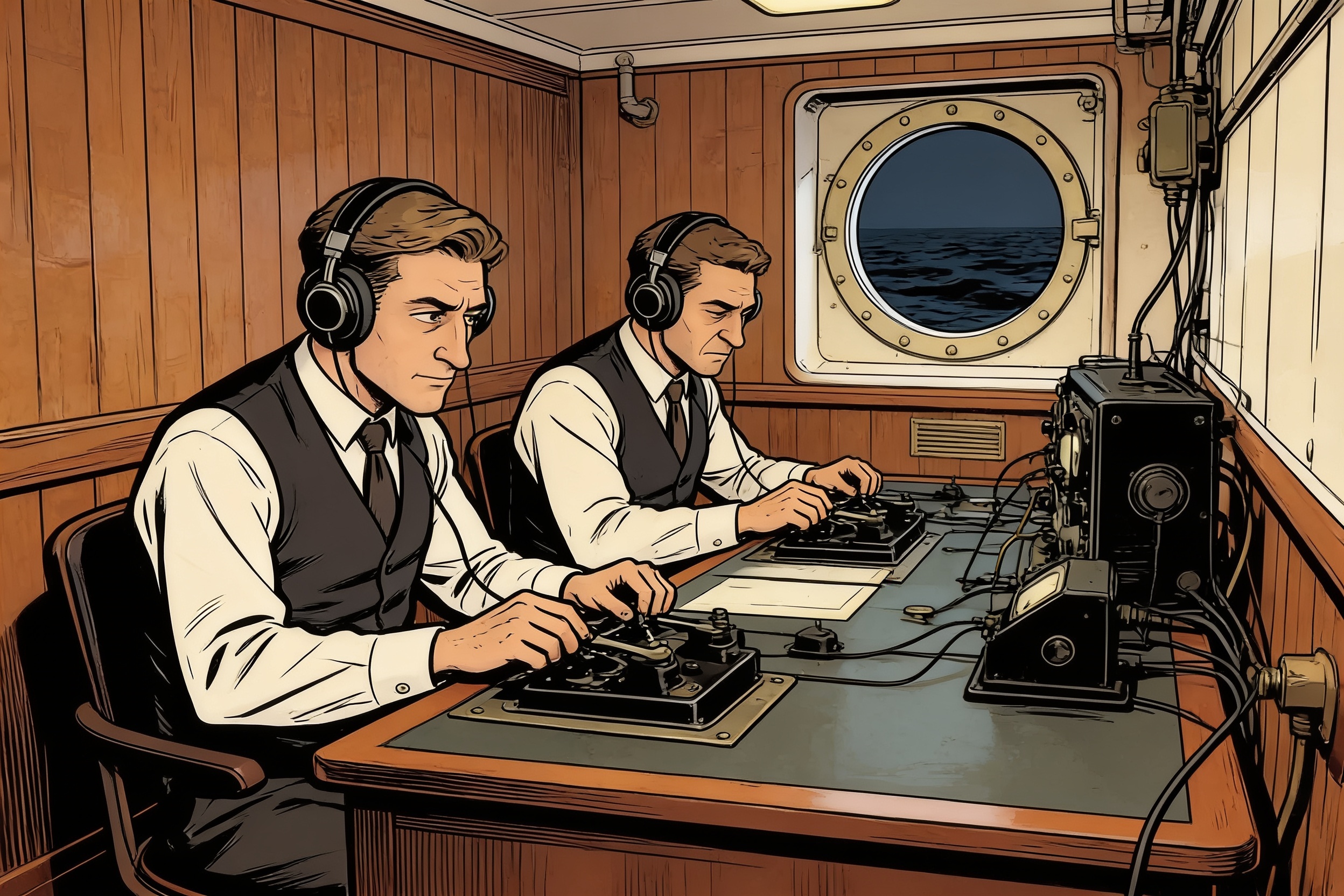
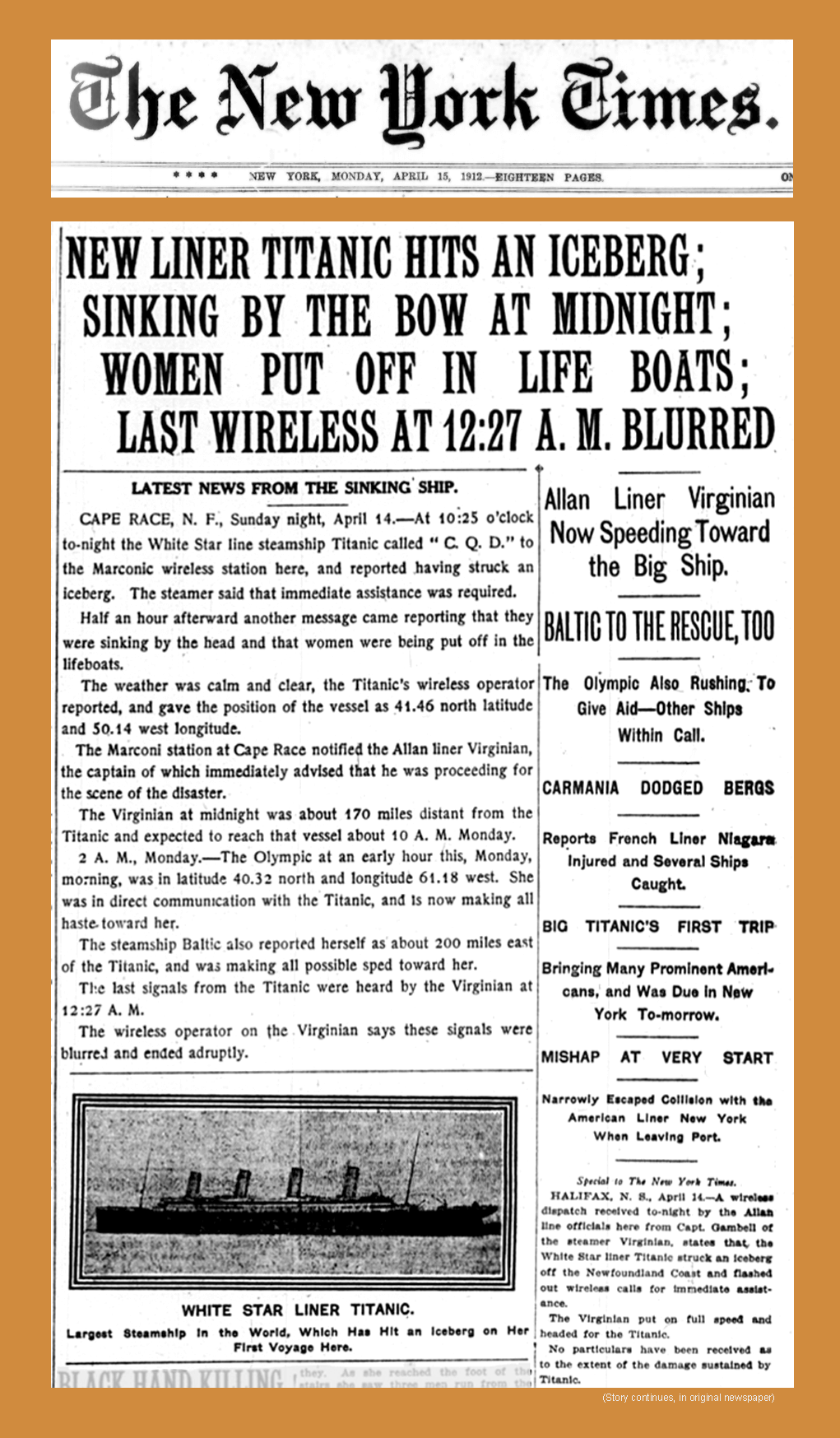
Throughout the day on April 14, the Titanic received multiple ice warnings from other ships. The Caronia, the Baltic, the Amerika, and the Californian all reported icebergs and field ice in the ship's path. Some of these messages were delivered to the bridge, but not all of them. One critical warning from the Mesaba was not delivered, as the wireless operators were busy with a backlog of passenger messages. The bridge was aware of ice ahead, but the prevailing practice was to maintain speed and rely on the lookouts to spot hazards in time.
- Ice warnings vs. Titanic track
- April 14, 1912 · 12:00–23:40
- Ice warning sources
- Caron
- Baltic
- Amerika
- Mesaba
- Californian
- Map of North Atlantic showing Titanic track and ice warnings
- Titanic 23:40
- Apr 14 track WS→W
- Titanic
- Ice
- Select a ship
- to see its ice warning plotted against Titanic's route.
The sea was unusually calm that night, with no moon. This made icebergs incredibly difficult to spot, as they gave no warning of their presence in the water. The lookouts in the crow's nest had no binoculars, relying on their naked eyes to pierce the darkness. The stage was set for a collision that the ship's designers had never imagined.
The Night of April 14 and the Collapse of the Colossus
The night of April 14, 1912, was clear and bitterly cold. The sea was like glass, a perfect mirror for the stars. At 11:40 PM, lookout Frederick Fleet spotted a dark shape directly in the ship's path. He rang the bell three times and phoned the bridge: "Iceberg, right ahead!"
First Officer William Murdoch ordered the ship to turn hard to port and the engines to be reversed. The maneuver was a gamble. The Titanic was too large and moving too fast to avoid the iceberg entirely. The ship's starboard side scraped along the ice, and the collision lasted only about 37 seconds. Many passengers felt nothing more than a slight shudder.
- 37‑second collision · starboard hull breach
- Iceberg
- Breached hull
- Ship path
- 5 compartments
- Spotting iceberg
- t = 0.0 s
- rudder left
But the damage was catastrophic. The iceberg had opened a series of gashes along the starboard hull, breaching at least five of the watertight compartments. The ship was designed to float with two compartments flooded, but not five. The water began to pour in, and the fate of the Titanic was sealed.
On the bridge, Captain Smith and Thomas Andrews, who had been called to assess the damage, quickly realized the ship was doomed. Andrews calculated that the Titanic had, at most, a couple of hours to live. The order was given to uncover the lifeboats and begin loading passengers. But there was a fatal flaw: the ship carried only 20 lifeboats, enough for about half of the people on board. They had been deemed sufficient because the Board of Trade's regulations were based on the ship's tonnage, not its passenger capacity.
- Passengers vs. Lifeboat capacity
- 2200 total aboard
- 20 lifeboats short
- Passengers aboard
- Passenger headcount slider
- Lifeboats
- · Seats
- Deficit
- Lifeboat capacity grid
- seat
- missing
- overload
- 20 lifeboats · 1178 seats
- 20 boats short
- Each dot = one passenger. Light blue = available seat, red = passenger without a seat (deficit).
The evacuation was chaotic. The "women and children first" protocol was enforced, but not consistently. Many of the first lifeboats were launched only partially filled, as passengers were reluctant to leave the "unsinkable" ship. As the bow sank lower and lower, the stern rose higher into the air, and the situation grew more desperate. The ship's band played on, trying to maintain calm.
At 2:20 AM on April 15, the Titanic broke in two and slipped beneath the waves. Over 1,500 people perished in the freezing water, either drowning or dying of hypothermia. The Carpathia, which had picked up the distress signals, arrived over an hour later to rescue the 705 survivors in the lifeboats. The "unsinkable" ship was gone, and the world would never be the same.
<page>