

A chat message that two people read differently
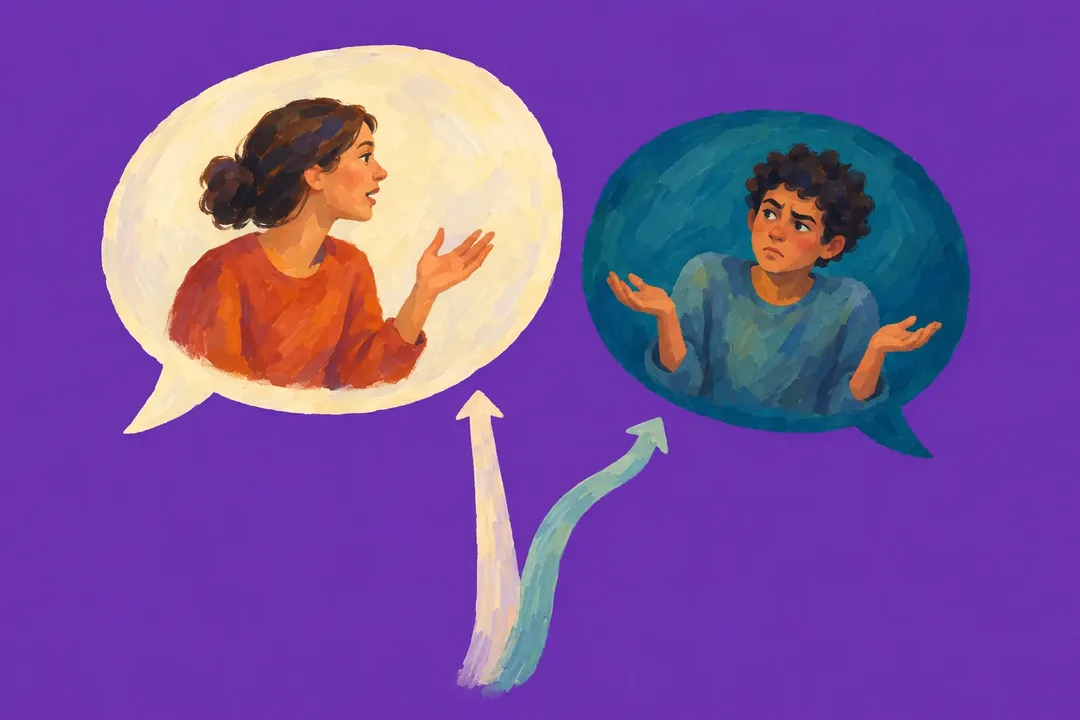
On a Friday at six in the evening, Valentina texts her cousin Andrés on WhatsApp: "Are you coming to grandma's birthday in Chía?" Andrés replies with two words: "I'm working." Valentina puts her phone on the table and tells her mom that Andrés isn't coming.

Andrés never wrote "I'm not coming". Valentina deduced that answer by putting her question together with what he replied. Linguists call this unwritten information that the context allows us to reconstruct an implicature.
Now imagine her mom answers, "He didn't say no; he just said he was working." She is literally right, yet almost no one would read the message that way. Many misunderstandings stem from this gap between what someone writes and what the other person understands.
The Saber 11 Critical Reading test works right on that border. Some questions ask for what the text says in plain terms; others ask for what can be concluded from it. In both cases, you must be able to point to the answer in the text. When there is nothing to ground it in, what you chose came from your head and not from the reading.
What the text states: literal reading
Literal comprehension consists of recognizing and retrieving explicit information—what the text says directly. It helps answer who did something, what happened, where, when, or what a word means in that paragraph.
The ICFES framework distinguishes two forms of this reading. In transcribed literal reading, the option repeats the words from the text. In paraphrase-based literal reading, the option says the same thing using different words, which poses the greatest difficulty because the exam almost never copies a sentence verbatim.
Look at this original excerpt:
The public library in the Manrique neighborhood of Medellín extended its hours until nine at night. The administration made this decision because many students work during the day and can only read after leaving.
A faithful paraphrase would be "The library opens later to serve those who study after work". It does not repeat any phrase, but it keeps who is acting, what changed, and why. A false paraphrase would be "The library opens at night because it has few visitors during the day". It keeps the topic, but changes the cause.
| What to check | Question to ask yourself |
|---|---|
| Subject | Is the same person or institution doing the same thing? |
| Action | Does the verb say the same thing or something stronger? |
| Quantity | Does the text say “many” while the option says “all”? |
| Cause | Is the reason the one given by the text? |
| Time and place | Are the moment and the location maintained? |
Literal reading also includes the relationships that the text expresses explicitly. When a sentence says “because”, “that is why”, or “in order to”, the cause or purpose is in plain sight and needs no deduction.
- The Manrique neighborhood public library
- , in Medellín,
- extended its hours
- until nine at night
- The administration
- made the decision
- because
- many
- students
- work during the day and can only read when they finish
- The library
- opens at night
- because it has few visitors during the day
- All of
- the students
- work during the day
- and read when they finish
- The Manrique library
- until midnight
- decided to extend the hours
- until nine
- Tap what the text does not say
- That is indeed in the text
- Changed the cause
- Exaggerates the amount
- Changed the time
- Changed who acts
- Option A
- A
- Option B
- B
- Option C
- C
- Option D
- D
What the text suggests: inference
To infer is to construct a meaning that the text does not express directly by connecting parts of the text to arrive at a conclusion. ICFES calls this task global comprehension because it requires looking at how sentences relate to one another.
Every inference has the same structure. You start from one or more written clues, connect them, and arrive at something the author did not say with those words. If someone asks you “well, where is that written?”, you can point to the clues even if you cannot point to the conclusion.
At the beginning of the semester, Mariana sat in the back row of her chemistry class at her school in Cali. By October, she was already asking questions out loud and staying during recess to review exercises with the teacher. In December, she joined the science club.

The text never states that Mariana started liking chemistry. You infer this from three clues pointing in the same direction: she went from sitting in the back row to participating, spent her free time on the subject, and signed up for a club on her own. A single clue would be weak; three reinforcing ones support the conclusion.
From clue to conclusion
- Written clue: “sat in the back row.”
- Written clue: “asked questions out loud and stayed in during recess.”
- Written clue: “joined the science club.”
- Relationship: the order of the clues shows a change over time.
- Conclusion: Mariana became increasingly interested in chemistry.
Pay attention to what the conclusion does not claim. It does not state that Mariana wants to study chemistry in college or that the teacher is the reason for the change. Those ideas might be true, but the text provides no clues for them.
- Possible conclusions
- More interest
- Chemistry in college
- Because of the teacher
- Good grades
- “Mariana grew more and more interested in chemistry”
- Three clues point to the same shift.
- “Mariana wants to study chemistry in college”
- None of the clues mention college.
- “The teacher caused Mariana's shift”
- The text mentions her, but not as the cause.
- “Mariana got good grades in chemistry”
- The text does not mention grades.
- The three text clues about Mariana
- At the start of the semester,
- Mariana
- sat in the back row
- of chemistry class.
- By October,
- she was already
- asking questions out loud and staying in during recess
- going over exercises
- with the teacher.
- In December,
- she joined the science club.
Clues that support an inference
Clues are not hidden. They are almost always concrete words that anyone can underline, and exam texts tend to repeat a few specific types.
Connectors show how two ideas relate. “However” signals that what follows limits or contradicts what came before; “in contrast” contrasts two cases; “consequently” presents a result. If a text states, “Many believe that the motorcycle taxi is dangerous. However, in some municipalities it is the only transportation,” you can infer that the author does not entirely accept the first idea.
- Connector between the two sentences
- however
- furthermore
- therefore
- on the other hand
- Many believe that the mototaxi is dangerous.
- However,
- Furthermore,
- Therefore,
- On the other hand,
- in some municipalities it is the only means of transportation.
- It does not fully accept it
- It accepts it and adds another
- It turns it into a cause: it does not fit
- It contrasts two cases
- A seesaw with a danger sign on one side and a mototaxi on the other, tipping depending on the connector
Adjectives and verbs reveal the writer's perspective. If you compare “the mayor announced” with “the mayor finally admitted,” you see the difference: “finally admitted” suggests that he was previously denying it.
The order of the information also speaks volumes. What an author puts at the end of a paragraph is usually the conclusion they wanted to reach, and a sequence of events can show a change, as in Mariana's case.
What the text omits matters just as much as what it includes. If a restaurant review in Cartagena praises the ocean view, the decor, and the music, but never mentions the food, it is reasonable to infer that the food was not what stood out most to the writer.

| Type of clue | Example | What it allows you to infer |
|---|---|---|
| Connector | “however” | The author qualifies the previous idea |
| Loaded word | “finally admitted” | There was prior resistance |
| Order | Events from January to December | A change over time |
| Omission | The review does not mention the food | It was not the most notable aspect |
To check an inference, name at least one clue and ask yourself whether a different conclusion would fit just as well. If just as many options fit, the clue is insufficient.
When the reader assumes too much
A valid inference relies on clues within the text. An over-inference or assumption adds something the text does not support, and usually stems from the reader's experience, opinion, or imagination.
When the teacher handed back the practice test scores, Julián folded his paper without looking at it, put it in his pocket, and left the room before everyone else.

You can infer that Julián was worried about his scores or that he did not want to see them in front of others. The clues support this because he folds the paper without looking and leaves first. You cannot infer that he did poorly, because he doesn't even know his score yet. Nor can you infer that his parents will scold him, because the text says nothing about his family.
There are three common ways to assume too much. The first is to use your knowledge of the world as if it were in the text, such as thinking that it always rains in Bogota in April. The second is to insert your opinion, such as turning “the author describes reggaeton” into “the author criticizes reggaeton”. The third is to generalize from a single case, such as going from “Julián left quickly” to “students hate practice tests”.
A quick test works well here. Ask yourself which word in the text supports your conclusion, whether the conclusion is certain or merely possible, and whether you are adding information that does not appear.
- Text about Julián and the mock test
- “When the teacher handed out the mock test results, Julián
- folded the paper
- without looking at it
- put it in his pocket
- and
- left the classroom before everyone else”
- A
- “Julián did poorly”
- What word in the text supports this?
- Not even he has seen his score.
- B
- “He didn't want to see the result in front of others”
- The clues are underlined.
- C
- “Julián was rude to the teacher”
- The text describes; it doesn't judge.
- D
- “The results worried him”
- E
- “Students hate mock tests”
- A single case doesn't speak for everyone.
- F
- “His parents are going to scold him”
- The text doesn't mention his family.
- Ways of assuming too much
- World knowledge
- Opinion
- Generalization
- Supported by the text
- You are assuming too much
- Next
- Try again
- Statement A
- Statement B
- Statement C
- Statement D
- Statement E
- Statement F
How traps are built in the options
Each Critical Reading question has four options and only one correct answer. The other three are designed to look plausible. Since traps follow patterns, recognizing how they are constructed saves you time.
In Manizales, bicycle use increased in neighborhoods where bike lanes were built, especially among university students.
With that text, you can build the four most common traps.
- In Manizales,
- bicycle use increased
- in neighborhoods where bike lanes were built
- , especially among college students.
- Throughout Manizales,
- bicycle use increased.
- Bike lanes were built
- because
- college students were already riding.
- Riding a bicycle
- improves health
- Bike lanes increased
- among college students.
- Again
- Which trap was used?
- Not that one. Look at the underlined part
- The text: only certain neighborhoods
- First bike lanes, then more bicycles
- That might be true, but it is not in the text
- What increased was bicycle use
- One sentence, four traps
- True outside
- Exaggerates
- Reversed cause
- Other subject
| Trap | Example option | Why it fails |
|---|---|---|
| True in the world, absent from the text | Bicycles reduce pollution | It may be true, but the text does not say so |
| Exaggeration | All residents of Manizales ride bicycles | The text speaks of certain neighborhoods and a specific group |
| Reversed cause | Bike lanes were built because there were more cyclists | The text presents the bike lanes before the increase |
| Same words, different meaning | University students built bike lanes | It uses terms from the text with a different subject |
The first trap tricks good students because they know things. The exam question says “according to the text”, and an option that is true in real life remains incorrect if the text does not support it.
Absolute words like “always,” “all,” “never,” or “only” deserve suspicion. They are not automatically false: if the text says “all”, the option may repeat it. What you must compare is the scope of the option with that of the text.
The correct answer matches the text's content, the scope of its claims, and what the prompt asks for all at once. If it falls short on any of those three, it is a distractor.

A two-minute method to answer
On the Saber 11 test you have about two minutes per question. A fixed routine keeps you from rereading the whole text every time and forces you to justify your answer with something concrete. It is not an official ICFES procedure, but a practical strategy based on the competencies the test evaluates.
- Read the prompt first. Mark words like “según el texto,” “se puede inferir,” “principalmente” or “NO”.
- Determine what you are being asked. “Según el texto” usually asks for a literal fact; “se puede inferir” asks for a conclusion based on clues.
- Locate the clue. Go back only to the relevant paragraph and mentally underline the phrase.
- Eliminate with a reason. Rule out each option by stating why it fails: it adds something, exaggerates, reverses the cause, or changes the subject.
- Compare the two remaining options word for word. There is usually a small difference in quantity, time, or cause.
- Read
- Decide
- Locate
- Eliminate
- Compare
- A coffee growers cooperative in a Quindío municipality started selling roasted coffee in branded bags.
- Previously, it only sold green coffee beans
- to intermediaries. In the first year, the members
- received a better price per pound.
- What
- can be inferred
- about the change?
- A
- All
- coffee growers in Quindío
- should
- roast their coffee.
- B
- Selling roasted coffee
- benefited the members.
- C
- The better price led to
- creating the brand.
- D
- tripled income.
- Tap what you are asked to find
- Look for the verb in the question
- What are you asked to find?
- A literal fact
- A conclusion based on clues
- “Infer” does not mean copying a fact
- Tap the two clues in the text
- Look for the before and the result
- Cross out two options and explain why
- Adds something new
- Exaggerates
- Reverses the cause
- Changes the subject
- First, tap an option
- The text actually supports that one
- That reason does not fit
- Compare the finalists: which one stays?
- The text does not say that
- I choose B because the text says
- Try again
Try the routine with this case.
A coffee growers' cooperative in a Quindío municipality began selling roasted coffee in branded bags. Before, it had sold only green coffee beans to intermediaries. In the first year, members received a better price per pound.

If the question asks, “What can be inferred about the change?”, you are looking for a conclusion. The clues are the contrast between “before” and “now” and the result of the “better price”. A valid inference would be that selling a finished product benefited the members. An option like “All coffee growers in Quindío should roast their coffee” exaggerates the scope and gives advice that the text does not provide.
Sources
References
- 9.4.1: Implicatures and the semantic/pragmatic boundary — 2022
- The misunderstanding — 2020
- misunderstandings in verbal communication
- www.icfes.gov.co › wp-content › uploadsPrueba de Lectura Crítica Saber 11.°, Saber TyT y Saber P
- Saber 11.º Exam Orientation Guide
- Saber 11.°, Saber TyT, and Saber Pro Critical Reading Test
- R E A D T O K N O W M O R E
- ppt inferencia.pptx language and communication — 2024
- Inference vs. Assumption (2p) — 2025
- [PDF] PRACTICE – PART II READING COMPREHENSION TECHNIQUES
- Saber 11º Exam Orientation Guide
- Critical Reading
- entrenau.com › co › saber-11How to Identify Distractors in the ICFES Saber 11 — 2026
- Eliminating distractors in ICFES critical reading without rereading — 2026
- Critical Reading
- saber911.com › blog › distractores-lectura-criticaDistractors in ICFES critical reading — How to identify them and... — 2026
Frequently asked questions
What is an implicature in reading?
An implicature is unwritten information that the context allows readers to reconstruct. For example, when Andrés replies "I'm working" to a question about a birthday, Valentina deduces he isn't coming even though he never wrote that. Linguists call this gap between what is written and what is understood an implicature.
What is the difference between literal comprehension and inference on the Saber 11?
Literal comprehension means recognizing and retrieving explicit information the text states directly, such as who did something, what happened, where, when, or what a word means. Inference means constructing a meaning the text does not express directly by connecting clues to reach a conclusion. ICFES calls inference global comprehension.
What is the difference between a faithful paraphrase and a false paraphrase?
A faithful paraphrase says the same thing using different words while keeping who is acting, what changed, and why. A false paraphrase keeps the topic but changes a key element, such as the cause. For example, saying a library opens later to serve students who work is faithful; saying it opens at night because it has few visitors is false.
How do you know if an inference is supported by the text?
Every inference starts from one or more written clues, connects them, and arrives at a conclusion the author did not state in those words. You should be able to point to the clues even if you cannot point to the conclusion. A single clue is weak; several reinforcing clues support a firm inference.
What kinds of clues support an inference in reading?
Clues are concrete words that anyone can underline. Connectors show how two ideas relate: "however" signals that what follows limits or contradicts what came before, "in contrast" contrasts two cases, and "consequently" presents a result. Exam texts tend to repeat a few specific types of clues.