

A childhood on everyday prosthetics in Tennessee
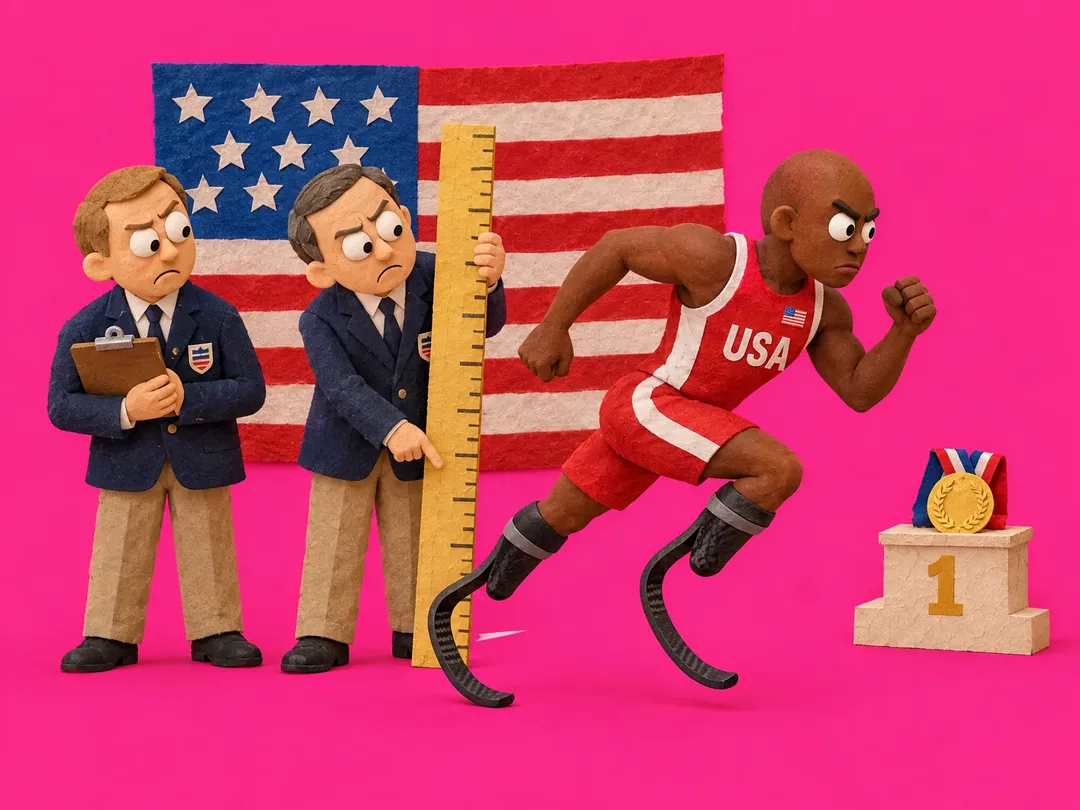
In 2019, at the USA Track & Field Championships, Blake Leeper crossed the 400-meter finish line in 44.38 seconds, a time that would have made the final at most Olympic Games. He ran it on two carbon-fiber blades, because he was born in 1989 in Kingsport, Tennessee, without legs below the knee.
The condition is called congenital limb deficiency, which means the limbs never fully formed before birth. Leeper did not lose his legs. He grew up learning to walk on prosthetics, and a child who keeps growing outgrows them. Every growth spurt meant a new fitting, new sockets rubbing against the skin, and weeks of adjustment while friends simply put on bigger shoes.
Everyday prosthetics are built for walking. They have a stiff foot and a design that favors stability over speed, so a boy on them can play, climb, and chase, but he cannot sprint the way a boy on biological legs can. His family raised him in modest circumstances, and every new pair of legs had to be paid for or negotiated through insurance.
That early life fixed two facts that would follow him into elite sport. Equipment decides what an amputee athlete can attempt, and money decides what equipment he gets.
From wheelchair basketball to running blades
Leeper's first competitive outlet was wheelchair basketball, a sport where the chair is standard and nobody's legs matter. Running came later, during his college years, once he got access to running-specific prostheses, the J-shaped carbon-fiber blades that most Paralympic sprinters now use.
A blade works like a spring. When the runner lands, the curved carbon compresses and stores energy, then releases it as the foot leaves the track. A biological leg does something similar with tendons and muscle, but it also has an ankle that pushes off with muscle power. The blade cannot push, so the athlete has to generate speed from the hips and trunk and let the carbon return the energy.
- Retorno elástico
- Empuje muscular
- Hoja de carbono
- Pierna biológica
- Retorno elástico y empuje muscular
- Almacena energía
- Devuelve energía
- El gemelo empuja
- Sin músculo
- Fase aérea
- Tendón
These blades are custom-made, fitted to the athlete's residual limbs, and they wear out. A single blade plus its socket typically costs many thousands of dollars, and a sprinter on two legs needs a pair, spares, and a separate set of everyday prosthetics for walking. Health insurers in the United States often classify running blades as recreational rather than medically necessary, so families and athletes pay out of pocket or rely on sponsors and charities.
For an athlete from a low-income family, that price works as a qualifying standard before any race. Leeper cleared it with help from donors and sponsors, and the talent that money unlocked moved fast.
London 2012 and the Paralympic podium
Three years after taking up serious sprinting, Leeper stood in the London Olympic Stadium as a member of the U.S. Paralympic team. He won silver in the 400 meters T44 in 50.14 seconds and bronze in the 200 meters T44 in 22.46 seconds, and he finished fifth in the 100 meters.
The man who beat him in the 400 was Oscar Pistorius, the South African double amputee who had run in the Olympic Games a few weeks earlier. Pistorius had already won his own legal battle in 2008, when the Court of Arbitration for Sport ruled that World Athletics (then called the IAAF) had not proved his blades gave him an advantage. That precedent shaped everything Leeper would later face.

The following year Leeper kept climbing. At the 2013 IPC World Championships in Lyon he took silver in the 100, 200, and 400 meters and gold in the 4×100-meter relay, where the U.S. team set a world record of 40.76 seconds. Team USA counts his career haul as one Paralympic silver, one Paralympic bronze, and six world championship medals.
Suspension, setbacks, and starting over
The rise stopped in 2015. Leeper received a doping suspension after a positive drug test, and the ban ran long enough to wreck his plans for the Rio 2016 Paralympics. He had been named to the U.S. team for Rio but did not compete.
For a sprinter in his mid-twenties, losing a Paralympic cycle costs more than one race. Sponsorship money follows medals and visibility, and blades still had to be replaced. Leeper later spoke publicly about the period as a personal low, and the suspension remains part of his record that no comeback erased.
He came back with a different target. Instead of only chasing Paralympic medals, he began training to race the fastest able-bodied 400-meter runners in the United States.
Breaking 45 seconds and world records
In 2017 Leeper ran 45.25 seconds, a world record for the T43 class, the category for double below-knee amputees. A year later he lowered his best to 44.42, the fastest 400 meters ever run by an amputee at that point.
At the 2019 USATF Championships he went faster again, 44.38 seconds, and finished fifth in an open national final against able-bodied runners. For scale, the men's world record, set by Wayde van Niekerk in 2016, stands at 43.03.
Those times made Leeper a realistic candidate for the U.S. relay pool for the Tokyo Olympics. They also made World Athletics look closely at his blades, because a double amputee who keeps getting faster raises an obvious question about whether his legs are giving him something biology would not.
The fight for Tokyo: Maximum Allowable Standing Height
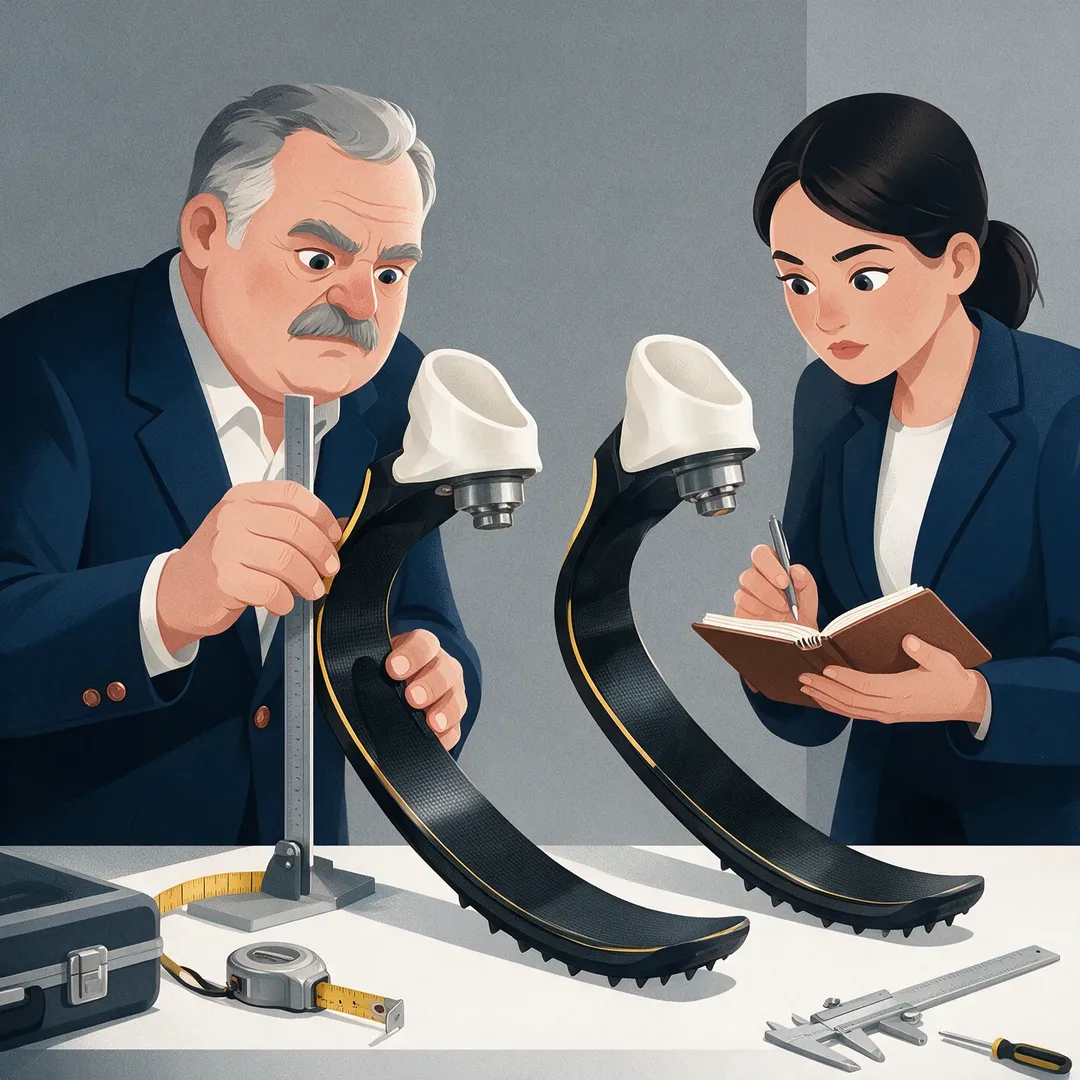
World Athletics measured Leeper standing on his racing blades at 189.2 centimeters, about 6 feet 2¼ inches. The federation then asked how tall he would probably be with biological legs, and for that it used a tool from Paralympic sport called MASH, the Maximum Allowable Standing Height.
MASH predicts a double amputee's natural height from body parts he still has. It weights the length of the thigh, the upper arm, the forearm, and the sitting height, each by a coefficient drawn from population studies, and adds a small error margin.
$$
\text{MASH} = c1(\text{thigh}) + c2(\text{upper arm}) + c3(\text{forearm}) + c4(\text{sitting height}) + 1.91\ \text{cm}
$$
For Leeper the formula gave 174.4 centimeters, about 5 feet 8½ inches. The gap of roughly 15 centimeters meant, in the federation's view, that he was running "unnaturally tall," with legs proportioned like those of a much taller sprinter and a longer stride to match.
- Runner beside a centimeter scale
- 174.4 cm
- 189.2 cm
- cm
- Height mode
- MASH Baseline (174.4 cm)
- Blade Height (189.2 cm)
- MASH height
- stride
Leeper argued that the formula was the problem. The studies behind MASH were small and, critics noted, included no Black participants, while Black athletes on average tend to have longer legs relative to their torso. Researchers at the University of Colorado also argued that blade height does not straightforwardly translate into faster 400-meter times. World Athletics replied that the formula used the best evidence available and that racial differences could not explain a gap this large.
The CAS decision and the barrier of mechanical advantage
Leeper took his case to the Court of Arbitration for Sport in Lausanne, the body that settles international sports disputes. On 26 October 2020, in the case CAS 2020/A/6807, the panel delivered a split result.
Leeper won on the rule itself. World Athletics had required athletes using mechanical aids to prove that the device gave them no overall advantage, and CAS found that unfair, because an athlete cannot reasonably prove a negative about his own body. The court moved the burden onto the federation.
He lost on the facts. Even with the burden reversed, CAS accepted World Athletics' evidence that his blades made him taller than his MASH and gave him an overall competitive advantage in the 400 meters, which the federation estimated could reach several seconds. The court also noted that MASH was not a rule of able-bodied athletics, only an objective yardstick for his likely height.
Leeper tried again with shorter blades that put him at 184 centimeters. In 2021 a World Athletics review panel rejected them too, since they still sat 9.6 centimeters above his MASH. He did not run at the 2021 or 2024 Olympic Trials.
What fairness means when bodies differ
Paralympic sport and able-bodied sport handle difference in opposite ways. The Paralympics sort athletes into classes such as T43 or T62 so that people with similar impairments race each other, and MASH exists there to stop anyone from gaining height by choosing longer blades. Olympic athletics assumes everyone arrives with biological legs and treats any device as a possible distortion.
Leeper's case sits on the seam between those systems. A blade is accommodation that lets him run at all, and it is also a piece of engineering whose length he can choose, which no able-bodied rival can do with his femurs. The CAS ruling made the rules fairer to athletes by putting the burden of proof on the federation, yet it still closed the Olympic door on the one athlete who had pushed hardest against it.
The science stayed unsettled. Critics still question whether a formula built from small, non-diverse samples should decide an Olympic career. Leeper returned to the Paralympic track instead, and at Paris 2024 he finished fourth in the 400 meters T62 with a 47.32 and seventh in the 100 meters T64. He left without a medal, and he never got the Olympic race his 44.38 had earned him on the clock.
Sources
References
- World Athletics’ response to CAS announcement of decision in Leeper case | PRESS-RELEASE | World Athletics — 2020
- TAS xxx
- Blake Leeper: Paralympian loses Cas appeal to use prosthetics for Olympic qualification — 2020
- World Athletics panel decision on application from Blake Leeper | PRESS-RELEASES | World Athletics — 2021
- HEARD AT HALFTIME: Final athlete's Playbook includes sanctions ... — 2021
- Amputee Leeper loses appeal against ban his running blades — 2020
- [PDF] world athletics mechanical aids review panel in the matter of an ...
- Prosthetics post-Pistorius: CAS's decision in the case of ... — 2020
- CAS Dismisses Double Amputee's Appeal in Fight to Compete at the ... — 2020
- Court ruling barring ‘blade runner’ from Olympics is scientifically unfounded, studies suggest — 2020
- Blake Leeper - Wikipedia — 2012
- Blake Leeper | Keynote Speaker | AAE Speakers Bureau — 2026
- Too-Tall Tale: How Blake Leeper Lost His Olympic Shot But Changed World Rules
- Blake Leeper | Team USA — 2024
- World record-holding Paralympian visits Anniston High School — 2015
- Born without legs, Patrick 'Blake' Leeper became one of the ... — 2020
- Blade Runner Pistorius takes gold in 400m — 2019
- 2024 United States Olympic trials (track and field) - Wikipedia — 2022
- Permohonan Leeper ikuti kompetisi dunia kaki palsunya ditolak - ANTARA News Bali — 2026
Audiovisual sources
- File:Oscar Pistorius, the first round of the 400m at the London 2012 Olympic Games.jpeg — Jim Thurston, Wikimedia Commons · CC BY-SA 2.0
- Black carbon Ossur Flex-run prosthetic blade with yellow band, displayed on green background. — ebay.com
- Össur Flex-Run distance running blade with Nike sole, a curved carbon fibre blade designed for road running and longer distances — alignprosthetics.com.au
Frequently asked questions
What is MASH in Paralympic sport?
MASH stands for Maximum Allowable Standing Height. It predicts a double amputee's natural height from body parts he still has, weighting the thigh, upper arm, forearm, and sitting height by coefficients from population studies and adding a 1.91 cm error margin. For Blake Leeper it gave 174.4 centimeters.
Why were Blake Leeper's blades banned from the Olympics?
World Athletics measured Leeper at 189.2 centimeters on his racing blades, about 15 centimeters above his MASH of 174.4 centimeters. The federation argued this made him run unnaturally tall, with a longer stride, and the Court of Arbitration for Sport accepted that his blades gave him an overall competitive advantage in the 400 meters.
How fast did Blake Leeper run the 400 meters?
Leeper ran 44.38 seconds at the 2019 USA Track & Field Championships, finishing fifth in an open national final against able-bodied runners. He had earlier run 45.25 seconds in 2017 and 44.42 in 2018, the fastest 400 meters ever run by an amputee at that point.
Why are running blades so expensive for amputee athletes?
A single carbon-fiber blade plus its socket typically costs many thousands of dollars, and a sprinter on two legs needs a pair, spares, and separate everyday prosthetics. Health insurers in the United States often classify running blades as recreational rather than medically necessary, so athletes pay out of pocket or rely on sponsors and charities.
What did the Court of Arbitration for Sport decide in Blake Leeper's case?
On 26 October 2020, in CAS 2020/A/6807, the panel delivered a split result. Leeper won on the rule, because CAS found it unfair to require an athlete to prove a negative about his own body, and moved the burden onto World Athletics. He lost on the facts, as CAS accepted that his blades gave him an overall competitive advantage.