
The reality behind the gaze
The reality behind the gaze
When you look around you, you see solid objects: a table, a telephone, a cup of coffee. You take for granted that they are there, with their weight, their color and their texture, regardless of whether you look at them or not. But what if what you call the "external world" were actually a sophisticated construction happening inside your head?

This is the question that divides the history of thought. For realism, things exist "out there" and our mind functions like a mirror that reflects them. For idealism, on the other hand, the mind is not a passive mirror: it is the canvas, the painter, and the frame. Without a perceiving, organizing, and interpreting consciousness, the world has no shape or meaning.
- Realism
- Idealism
- f(x,y)
- y = ax²
- The object exists independently of the subject. The eye acts as a passive mirror that captures the light reflected directly by the pre-existing apple.
- The subject actively constructs the object. The eye projects light, categories, and mathematical relationships that give shape, color, and intelligibility to an otherwise invisible reality.
The word is composed of the Greek term idéa (which refers to the shape, appearance or mode of appearing of something) and the suffix -ism (doctrine or system). Etymologically, idealism is the system that maintains that ideas are the principle of being and knowing. The term was not consolidated until the 18th century, when philosophers like Gottfried Wilhelm Leibniz and Christian Wolff began to use it to classify those who placed the spirit or the mind above matter.
The cave and the mold: Plato's idealism
Although the term was coined in modern times, the root of idealism dates back to 4th-century BC Athens. Plato did not call himself an idealist, but his philosophy laid the foundation for this school of thought by postulating that this physical world is only a blurry shadow of a higher reality.
Imagine a group of prisoners chained since childhood in the depths of a cave. They can only look at the back wall. Behind them, a fire illuminates a corridor where men walk carrying figures of animals and objects. The prisoners only see the shadows projected on the wall and naturally believe those shadows are the only reality.
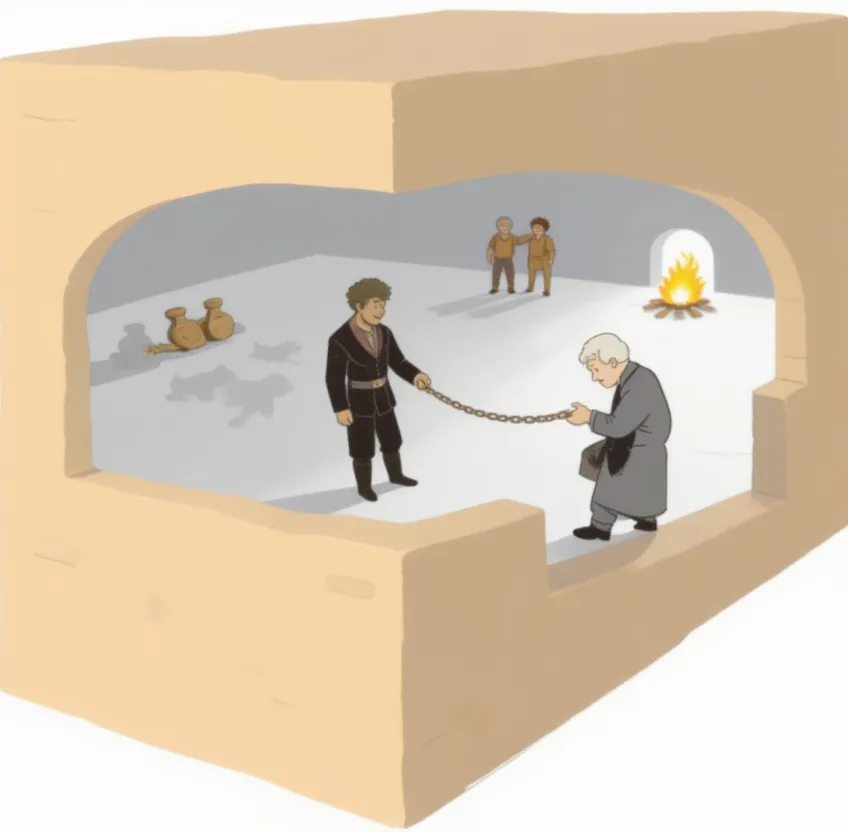
For Plato, we are those prisoners. The material world we touch and see is the wall of shadows. Physical objects change, age, and are destroyed; therefore, they cannot constitute absolute truth. The true reality resides in the World of Ideas (Intelligible World), a transcendent plane where the perfect and eternal molds of everything that exists dwell: the Idea of Justice, the Idea of Beauty, or the Idea of a Circle.
| Sensible World (Shadows) | Intelligible World (Ideas) |
|---|---|
| Access through the senses | Access through reason |
| Mutable, imperfect, and temporary things | Immutable, perfect, and eternal Ideas |
| Copies or imitations of the essence | Pure essences (the original molds) |
An artist can draw a circle in the sand, but that physical circle will always be imperfect if looked at with a magnifying glass. The perfect circle does not exist in the physical world; it exists solely as a geometric idea in thought. For Plato, that idea is more real than the stroke in the sand.
- Geometric abstraction versus matter
- r
- x² + y² = r²
- The real circle drawn in the physical world is always imperfect; pure geometry only exists as an idea.
Kant's Copernican revolution: The mind constructs the world
For centuries, idealism was understood as the search for a world of essences beyond our own. However, in 1781, the Prussian philosopher Immanuel Kant published his Critique of Pure Reason and changed the rules of the game forever through what he called his "Copernican revolution".
Before Copernicus, astronomy assumed that the Sun revolved around a stationary Earth. Copernicus demonstrated that the observer is also moving. In the same way, Kant argued that previous philosophers had wrongly assumed that our knowledge is limited to passively adapting to external objects. What if the object is the one that must adapt to the structure of our mind?
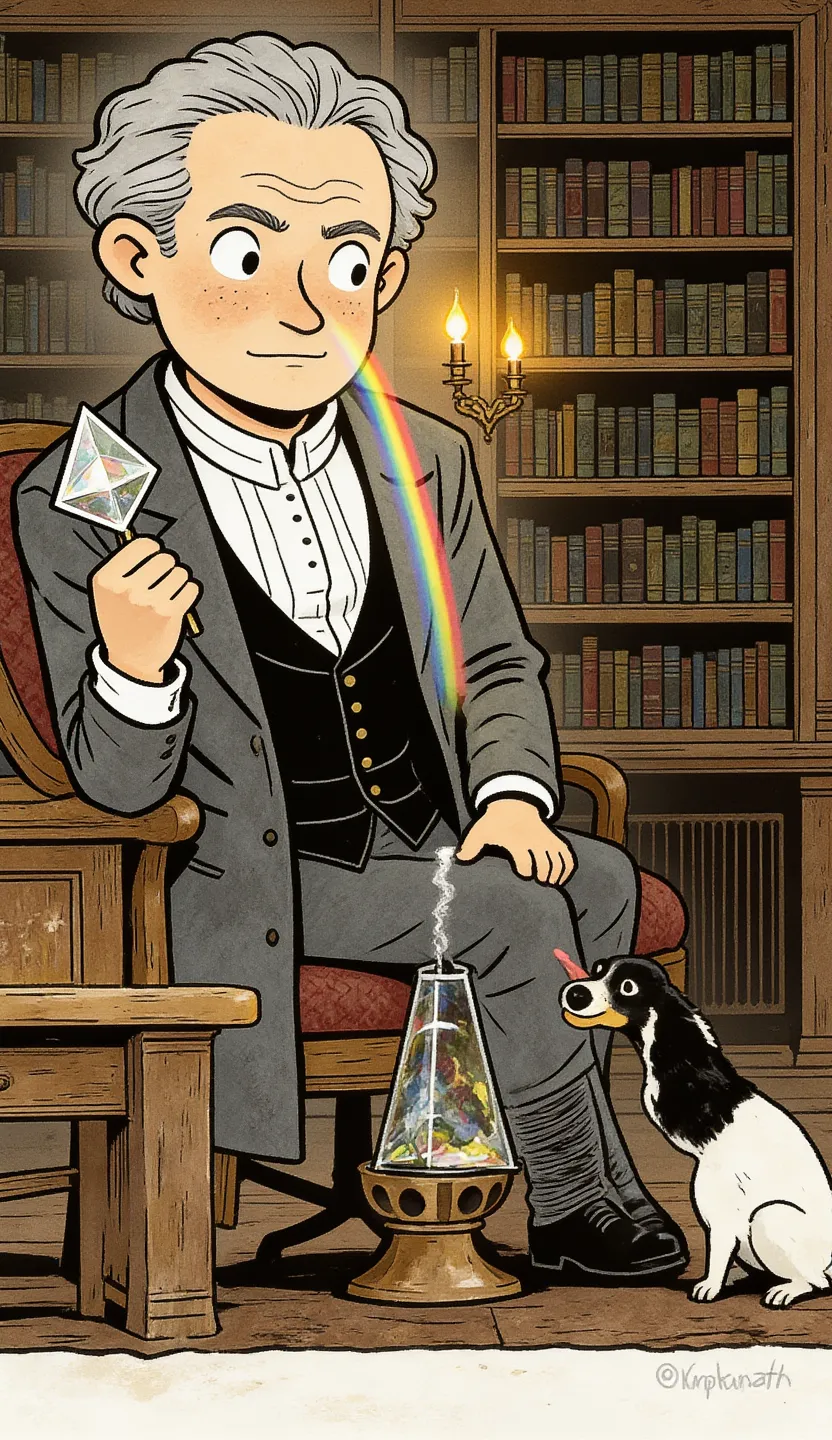
Kant founded transcendental idealism. He maintained that we can never know things as they are in themselves (the noumenon); we can only know things as they appear to us once processed by our mind (the phenomenon).
```
[Chaotic stimulus from the world] ➔ (Filters: Space and Time) ➔ (Categories of the Mind) ➔ [The Experienced Object]
```
For Kant, space and time are not real containers that are "out there" waiting for us to fill them. They are the lenses or software that our mind uses to organize sensations.
- The synthesis of the mind
- Transcendental filters of space and time
- Cognitive synthesis capacity
- Passive Mind (Total chaos)
- Active Mind (Ordered experience)
- Noumenon
- Space and Time
- Phenomenon
- Without the intervention of the mind, raw sensory data (noumenon) enters as an incomprehensible chaos. Activate the synthesis to process it.
If you were to take off those mental glasses, reality would lose all its structure. There would be neither a "here" nor a "later".
Idealism in daily life: Filters and expectations
Although these theories sound abstract, you experience idealism every second of your daily life through your psychology. You do not perceive the world raw; you perceive it filtered by your expectations, your cognitive biases, and your pre-existing beliefs.
Consider the confirmation bias. If you are convinced that a person is hostile, your mind will select and interpret every single one of their gestures (a silence, a quick glance, a neutral tone of voice) as clear confirmation of their hostility. Your subjective belief creates the social "reality" in which you live.
- Confirmation bias
- Drag the red lens over the messages to see how the expectation of hostility distorts a neutral dialogue.
- Colleague
- "Hi, do you have a moment to review the design changes?"
- You (Thought)
- "Sure, I can look at it now to move forward quickly."
- Perceived threat
- "Hi, do you have a moment? (They're coming to control my work and find mistakes)"
- Automatic defense
- "(If I don't reply right now, they'll think I'm inefficient or dodging them)"
- Expectation of hostility
- When we operate under a confirmation bias, the brain selectively and automatically searches for information that validates its prior suspicions, transforming other people's neutrality into clear hostility.
Expectations also alter your biology. The placebo effect is a classic example of practical idealism: the belief or idea that you are receiving a powerful drug triggers actual neurochemical responses that alleviate physical pain. The subjective idea modifies the chemistry of your body.
The canvas of the soul: Romanticism and symbolism
Towards the end of the 18th century and during the 19th century, German philosophical idealism intertwined with Romanticism in art and literature. Artists rebelled against the cold scientific rationalism of the Enlightenment, which sought to catalog the world as if it were a large mechanistic machine.
For the Romantic painter, the external landscape was not something to depict with photographic precision. It was a screen on which to project the storms of their soul. In the paintings of Caspar David Friedrich, such as Wanderer above the Sea of Fog, the vastness of nature is not geographical data; it is the visual representation of solitude, transcendence, and the abyss of the inner self.
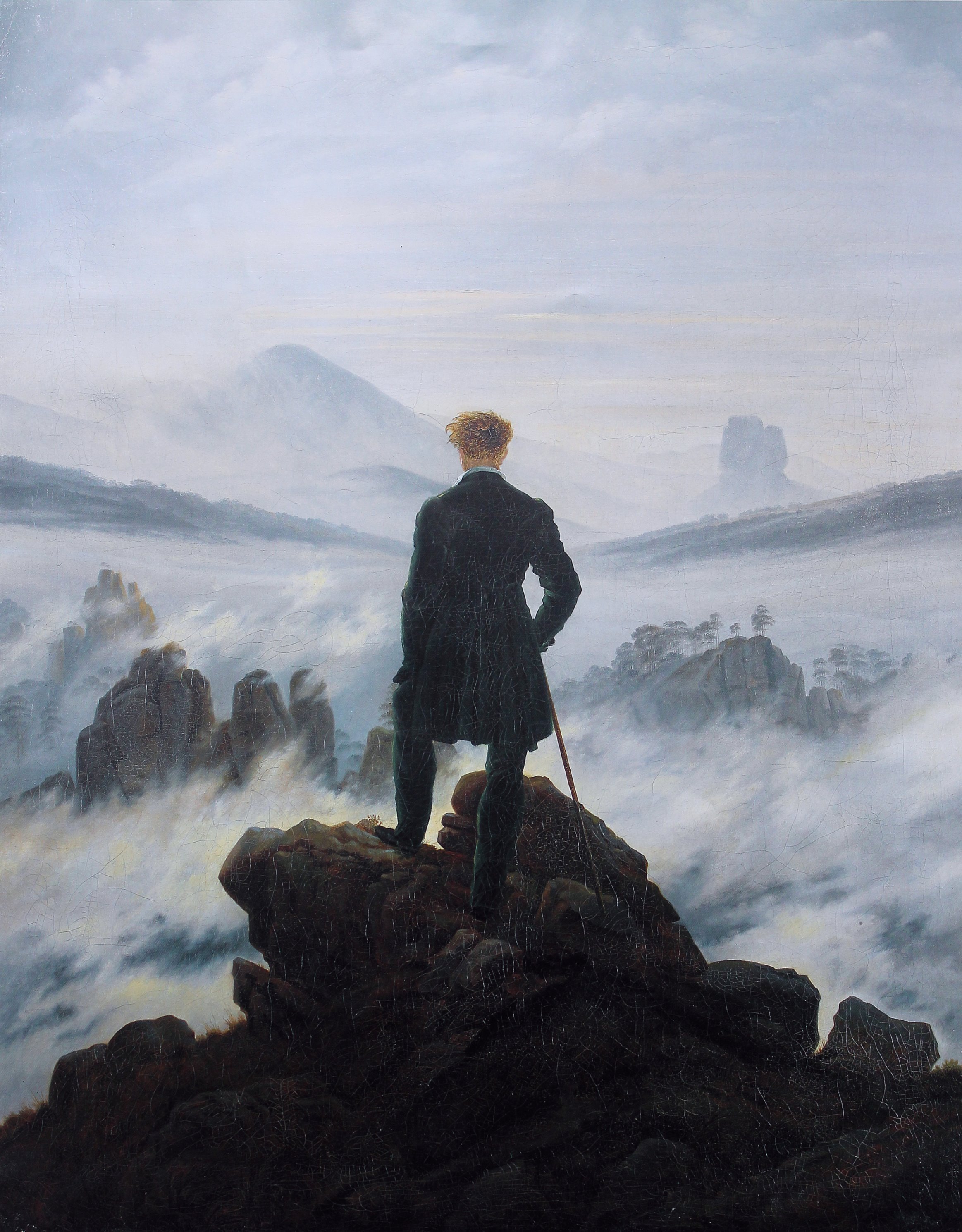
The movement deepened with Symbolism in the 19th century. Symbolist poets and painters decided that art should not imitate nature, but rather suggest ideas and states of consciousness through visual and musical symbols. The external world became a dictionary of metaphors to express the labyrinths of the artist's mind.
The big screen as mind: Mind-game film
Cinema is, by definition, the art of projecting light and shadow onto a wall to create the illusion of a world. In its first decades, it was used primarily to narrate objectively. But in contemporary cinema, a trend that theorists call mind-game films has emerged: movies where the screen no longer shows an actual external world, but the inside of the protagonist's head.
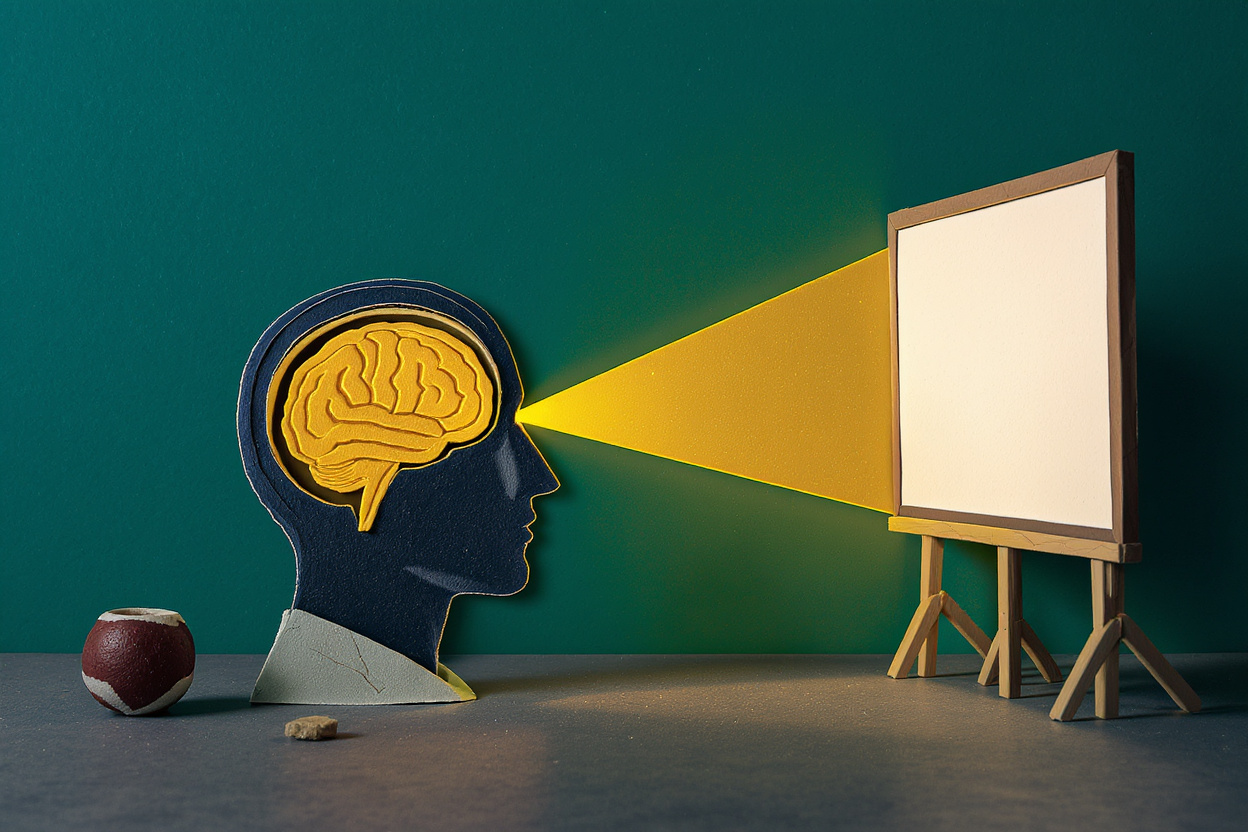
In this type of cinema, techniques such as fragmented editing, expressionist lighting, and non-linear narrative are used to immerse the spectator in an absolute idealism.
- Subjective camera: The framing shows us only what the character sees, assuming their optical and psychological limitations.
- Editing as a stream of consciousness: Temporal jumps (flashbacks or hallucinations) mix the narrative present with past traumas without warning.
- Distortion of the environment: Production design and settings visually reflect the emotional or mental state of whoever is walking through them.
Films that break the map: Matrix and Inception
Two cinematic milestones of the last decades take the theses of idealism to their ultimate physical and narrative expression: The Matrix (1999) and Inception (2010). Both challenge the certainty that the external world exists independently.
In The Matrix, idealism is presented under a digital science fiction wrapping. The city's skyscrapers, the rain hitting the windows, and the taste of the steak do not have a real physical existence: they are streams of computer code processed by the brains of people connected to an immense simulation.
The iconic scene of the Buddhist boy bending a spoon with his mind perfectly sums up this stance:
Do not try and bend the spoon. That's impossible. Instead... only try to realize the truth... There is no spoon. Then you'll see, that it is not the spoon that bends, it is only yourself.
Spoon boy — The Matrix (1999)
For its part, Inception explores an idealism of a more psychological and existential nature. The reality of the film is fragmented into different levels of shared dreams where the characters ("architects") design entire cities using the mind itself as raw material.
In this dream universe, the physical world loses solidity: the streets of Paris fold over themselves and gravity is altered according to the physical state of the dreamer in the layer above.
- Impossible geometry and gravity
- Perspective of a Parisian street folding 90° over itself
In the end, the film's plot does not move toward the resolution of an external conflict, but toward the resolution of an internal process: Dom Cobb's mind dealing with his own guilt and pain.